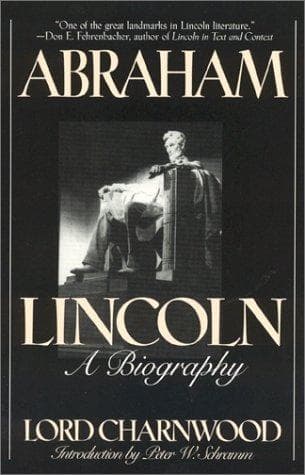
Abraham LincolnCharnwood, Godfrey Rathbone Benson, Baron
History
Abraham Lincoln
Charnwood, Godfrey Rathbone Benson, Baron
Lincoln, Abraham, 1809-1865; Presidents -- United States -- Biography
Each of these projects failed in turn. The tedious engineering work
which two of them involved was rendered more depressing by adverse
conditions of weather and by ill-health among Grant's men. Natural
grumbling among the troops was repeated and exaggerated in the North.
McClernand employed the gift for intrigue, which perhaps had helped him
to secure his command, in an effort to get Grant removed. It is
melancholy to add that a good many newspapers at this time began to print
statements that Grant had again taken to drink. It is certain that he
was at this time a total abstainer. It is said that he had offended the
authors of this villainy by the restrictions which he had long before
found necessary to put upon information to the Press. Some of the men
freely confessed afterwards that they had been convinced of his sobriety,
and added the marvellous apology that their business was to give the
public "the news." Able and more honest journalists urged that Grant had
proved his incompetence. Secretary Chase took up their complaints and
pressed that Grant should be removed. Lincoln, before the outcry against
Grant had risen to its height, had felt the need of closer information
than he possessed about the situation on the Mississippi; and had hit
upon the happy expedient of sending an able official of the War
Department, who deserved and obtained the confidence of Grant and his
officers, to accompany the Western army and report to him. Apart,
however, from the reports he thus received, he had always treated the
attacks on Grant with contempt. "I cannot spare this general; he
fights," he said. In reply to complaints that Grant drank, he enquired
(adapting, as he knew, George II.'s famous saying about Wolfe) what
whisky he drank, explaining that he wished to send barrels of it to some
of his other generals. His attitude is remarkable, because in his own
mind he had not thought well of any of Grant's plans after his first
failure in December; he had himself wished from an early day that Grant
would take the very course by which he ultimately succeeded. He let him
go his own way, as he afterwards told him, from "a general hope that you
know better than I."
Public-domain text, read in full here on John Shaqi.
Reviews
Reviews
No reviews yet
Be the first to share your thoughts on this work.
Elsewhere in the archive
Join the Discussion
Join the discussion
Sign in to leave a comment or review.
Sign InorCreate an account