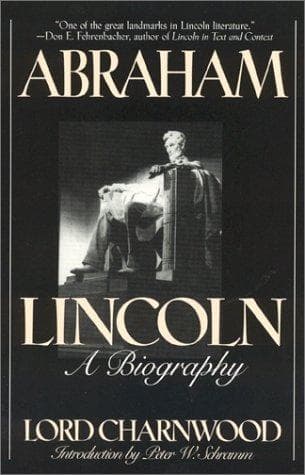
Abraham LincolnCharnwood, Godfrey Rathbone Benson, Baron
History
Abraham Lincoln
Charnwood, Godfrey Rathbone Benson, Baron
Lincoln, Abraham, 1809-1865; Presidents -- United States -- Biography
At the end of March Grant took a memorable determination to transfer his
whole force to the south of Vicksburg and approach it from that
direction. He was urged by Sherman to give up any further attempt to use
the river, and, instead, to bring his whole army back to Memphis and
begin a necessarily slow approach on Vicksburg by the railway. He
declared himself that on ordinary grounds of military prudence this would
have been the proper course, but he decided for himself that the
depressing effect of the retreat to Memphis would be politically
disastrous. At Grand Gulf, 30 miles south of Vicksburg, the South
possessed another fortified post on the river; to reach this Grant
required the help of the Navy, not only in crossing from the western bank
of the river, but in transporting the supplies for which the roads west
of the river were inadequate. Admiral Porter, with his gunboats and
laden barges, successfully ran the gauntlet of the Vicksburg batteries by
night without serious damage. Grand Gulf was taken on May 3, and Grant's
army established at this new base. A further doubt now arose. General
Banks in Louisiana was at this time preparing to besiege Port Hudson. It
might be well for Grant to go south and join him, and, after reducing
Port Hudson, return with Banks' forces against Vicksburg. This was what
now commended itself to Lincoln. In the letter of congratulation which
some time later he was able to send to Grant, after referring to his
former opinion which had been right, he confessed that he had now been
wrong. Banks was not yet ready to move, and Vicksburg, now seriously
threatened, might soon be reinforced. Orders to join Banks, though they
were probably meant to be discretionary, were actually sent to Grant, but
too late. He had cut himself loose from his base at Grand Gulf and
marched his troops north, to live with great hardship to themselves on
the country and the supplies they could take with them. He had with him
35,000 men. General Pemberton, to whom he had so far been opposed, lay
covering Vicksburg with 20,000 and a further force in the city; Joseph
Johnston, whom he afterwards described as the Southern general who in all
the war gave him most trouble, had been sent by Jefferson Davis to take
supreme command in the West, and had collected 11,000 men at Jackson, the
capital of Mississippi, 45 miles east of Vicksburg. Grant was able to
take his enemy in detail. Having broken up Johnston's force he defeated
Pemberton in a series of battles. His victory at Champion's Hill on May
16, not a fortnight after Chancellorsville, conveyed to his mind the
assurance that the North would win the war. An assault on Vicksburg
failed with heavy loss. Pemberton was at last closely invested in
Vicksburg and Grant could establish safe communications with the North by
way of the lower Yazoo and up the Mississippi above its mouth. There had
been dissension between Pemberton and Johnston, who, seeing that gunboats
Public-domain text, read in full here on John Shaqi.
Reviews
Reviews
No reviews yet
Be the first to share your thoughts on this work.
Elsewhere in the archive
Join the Discussion
Join the discussion
Sign in to leave a comment or review.
Sign InorCreate an account