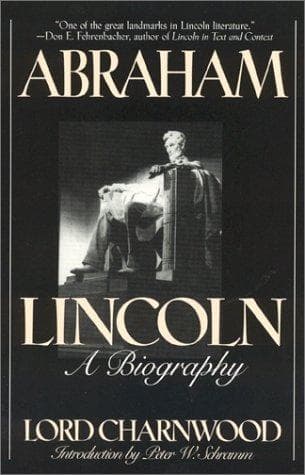
Abraham LincolnCharnwood, Godfrey Rathbone Benson, Baron
History
Abraham Lincoln
Charnwood, Godfrey Rathbone Benson, Baron
Lincoln, Abraham, 1809-1865; Presidents -- United States -- Biography
Northern troops had been contending with invisible enemies in woods; now,
after a heavy cannonade, the whole Southern line could be seen advancing
in the open to a desperate assault. This attack was crushed by the
Northern fire. First and last in the fighting round Gettysburg the North
lost 23,000 out of about 93,000 men, and the South about an equal number
out of 78,000. The net result was that, after a day's delay, Lee felt
compelled to retreat. Nothing but an actual victory would have made it
wise for him to persist in his adventurous invasion.
The importance of this, which has been remembered as the chief battle of
the war, must be estimated rather by the peril from which the North was
delivered than by the results it immediately reaped. Neither on July 3
nor during Lee's subsequent retreat did Meade follow up his advantage
with the boldness to which Lincoln, in the midst of his congratulations,
exhorted him. On July 12 Lee recrossed the Potomac. Meade on the day
before had thought of attacking him, but desisted on the advice of the
majority in a council of war. That council of war, as Lincoln said,
should never have been held. Its decision was demonstrably wrong, since
it rested on the hope that Lee would himself attack. Lincoln writhed at
a phrase in Meade's general orders about "driving the invader from our
soil." "Will our generals," he exclaimed in private, "never get that
idea out of their heads? The whole country is our soil." Meade,
however, unlike McClellan, was only cautious, not lukewarm, nor without a
mind of his own. The army opposed to him was much larger than that which
McClellan failed to overwhelm after Antietam. He had offered to resign
when he inferred Lincoln's dissatisfaction from a telegram. Lincoln
refused this, and made it clear through another officer that his strong
opinion as to what might have been done did not imply ingratitude or want
of confidence towards "a brave and skilful officer, and a true man."
Characteristically he relieved his sense of Meade's omissions in a letter
of most lucid criticism, and characteristically he never sent it. Step
by step Meade moved on Lee's track into the enemy's country. Indecisive
manoeuvres on both sides continued over four months. Lee was forced over
the Rappahannock, then over the Rapidan; Meade followed him, found his
army in peril, and prudently and promptly withdrew. In December the two
armies went into winter quarters on the two sides of the Rappahannock to
await the opening of a very different campaign when the next spring was
far advanced.
Public-domain text, read in full here on John Shaqi.
Reviews
Reviews
No reviews yet
Be the first to share your thoughts on this work.
Elsewhere in the archive
Join the Discussion
Join the discussion
Sign in to leave a comment or review.
Sign InorCreate an account