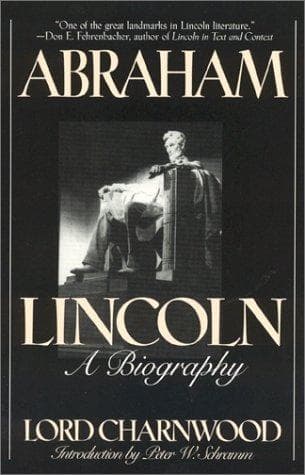
Abraham LincolnCharnwood, Godfrey Rathbone Benson, Baron
History
Abraham Lincoln
Charnwood, Godfrey Rathbone Benson, Baron
Lincoln, Abraham, 1809-1865; Presidents -- United States -- Biography
The autumn months of 1863 witnessed in the Middle West a varying conflict
ending in a Northern victory hardly less memorable than those of
Gettysburg and Vicksburg. At last, after the fall of Vicksburg,
Rosecrans in Middle Tennessee found himself ready to advance. By skilful
manoeuvres, in the difficult country where the Tennessee River cuts the
Cumberland mountains and the parallel ranges which run from north-east to
south-west behind, he turned the flank of Bragg's position at Chattanooga
and compelled him to evacuate that town in the beginning of September.
Bragg, as he retreated, succeeded in getting false reports as to his
movements and the condition of his army conveyed to Rosecrans, who
accordingly followed him up in an incautious manner. By this time the
bulk of the forces that had been used against Vicksburg should have been
brought to support Rosecrans. Halleck, however, at first scattered them
for purposes which he thought important in the West. After a while,
however, one part of the army at Vicksburg was brought back to General
Burnside in Ohio, from whom it had been borrowed. Burnside accomplished
the very advance by Lexington, in Kentucky, over the mountains into
Eastern Tennessee, which Lincoln had so long desired for the relief of
the Unionists there, and he was able to hold his ground, defeating at
Knoxville a little later an expedition under Longstreet which was sent to
dislodge him. Other portions of the Western army were at last ordered to
join Rosecrans, but did not reach him before he had met with disaster.
For the Confederate authorities, eager to retrieve their losses, sent
every available reinforcement to Bragg, and he was shortly able to turn
back towards Chattanooga with over 71,000 men against the 57,000 with
which Rosecrans, scattering his troops in false security, was pursuing
him. The two armies came upon one another, without clear expectation,
upon the Chicamauga Creek beyond the ridge which lies south-east of
Chattanooga. The battle fought among the woods and hills by Chicamauga
on September 19 and 20 surpassed any other in the war in the heaviness of
the loss on each side. On the second day Bragg's manoeuvres broke
Rosecrans' line, and only an extraordinarily gallant stand by Thomas with
a part of the line, in successive positions of retreat, prevented Bragg
from turning the hasty retirement of the remainder into a disastrous
rout. As it was, Rosecrans made good his retreat to Chattanooga, but
there he was in danger of being completely cut off. A corps was promptly
detached from Meade in Virginia, placed under Hooker, and sent to relieve
him. Rosecrans, who in a situation of real difficulty seems to have had
no resourcefulness, was replaced in his command by Thomas. Grant was
appointed to supreme command of all the forces in the West and ordered to
Chattanooga. There, after many intricate operations on either side, a
great battle was eventually fought on November 24 and 25, 1863. Grant
Public-domain text, read in full here on John Shaqi.
Reviews
Reviews
No reviews yet
Be the first to share your thoughts on this work.
Elsewhere in the archive
Join the Discussion
Join the discussion
Sign in to leave a comment or review.
Sign InorCreate an account