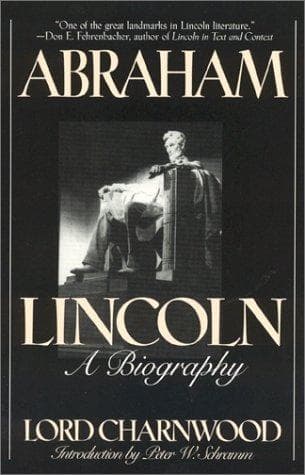
Abraham LincolnCharnwood, Godfrey Rathbone Benson, Baron
History
Abraham Lincoln
Charnwood, Godfrey Rathbone Benson, Baron
Lincoln, Abraham, 1809-1865; Presidents -- United States -- Biography
It is remarkable that, with his ever-burning desire to see
vigour and ability displayed, he could watch so constantly as he did for
the precise opportunity or the urgent necessity before he made changes in
command. It is equally remarkable that, with his decided and often right
views as to what should be done, his advice was always offered with equal
deference and plainness. "Quite possibly I was wrong both then and now,"
he once wrote to Hooker, "but in the great responsibility resting upon
me, I cannot be entirely silent. Now, all I ask is that you will be in
such mood that we can get into action the best cordial judgment of
yourself and General Halleck, with my poor mite added, if indeed he and
you shall think it entitled to any consideration at all." The man whose
habitual attitude was this, and who yet could upon the instant take his
own decision, may be presumed to have been wise in many cases where we do
not know his reasons. Few statesmen, perhaps, have so often stood
waiting and refrained themselves from a firm will and not from the want
of it, and for the sake of the rare moment of action.
The passing of the crisis in the war was fittingly commemorated by a
number of State Governors who combined to institute a National Cemetery
upon the field of Gettysburg. It was dedicated on November 19, 1863.
The speech of the occasion was delivered by Edward Everett, the
accomplished man once already mentioned as the orator of highest repute
in his day. The President was bidden then to say a few words at the
close. The oration with which for two hours Everett delighted his vast
audience charms no longer, though it is full of graceful sentiment and
contains a very reasonable survey of the rights and wrongs involved in
the war, and of its progress till then. The few words of Abraham Lincoln
were such as perhaps sank deep, but left his audience unaware that a
classic had been spoken which would endure with the English language.
The most literary man present was also Lincoln's greatest admirer, young
John Hay. To him it seemed that Mr. Everett spoke perfectly, and "the
old man" gracefully for him. These were the few words: "Four score and
seven years ago our fathers brought forth on this continent a new nation,
conceived in liberty and dedicated to the proposition that all men are
created equal. Now we are engaged in a great civil war, testing whether
that nation, or any nation so conceived and so dedicated, can long
endure. We are met on a great battlefield of that war. We have come to
dedicate a portion of that field as a final resting place for those who
here gave their lives that that nation might live. It is altogether
fitting and proper that we should do this. But, in a larger sense, we
cannot dedicate--we cannot consecrate--we cannot hallow--this ground.
The brave men, living and dead, who struggled here have consecrated it
far above our poor power to add or to detract. The world will little
Public-domain text, read in full here on John Shaqi.
Reviews
Reviews
No reviews yet
Be the first to share your thoughts on this work.
Elsewhere in the archive
Join the Discussion
Join the discussion
Sign in to leave a comment or review.
Sign InorCreate an account