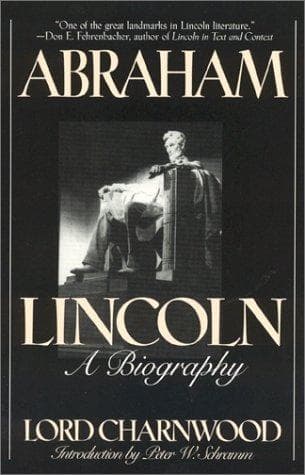
Abraham LincolnCharnwood, Godfrey Rathbone Benson, Baron
History
Abraham Lincoln
Charnwood, Godfrey Rathbone Benson, Baron
Lincoln, Abraham, 1809-1865; Presidents -- United States -- Biography
had about 60,000 men; Bragg, who had detached Longstreet for his vain
attack on Burnside, had only 33,000, but he had one steep and entrenched
ridge behind another on which to stand. The fight was marked by notable
incidents--Hooker's "battle above the clouds"; and the impulse by which
apparently with no word of command, Thomas' corps, tired of waiting while
Sherman advanced upon the one flank and Hooker upon the other, arose and
carried a ridge which the enemy and Grant himself had regarded as
impregnable. It ended in a rout of the Confederates, which was
energetically followed up. Bragg's army was broken and driven right back
into Georgia. To sum up the events of the year, the one serious invasion
of the North by the South had failed, and the dominion on which the
Confederacy had any real hold was now restricted to the Atlantic States,
Alabama, and a part of the State of Mississippi.
At this point, at which the issue of the war, if it were only pursued,
could not be doubted, and at which, as it happens, the need of Lincoln's
personal intervention in military matters became greatly diminished, we
may try to obtain a general impression of his wisdom, or want of it, in
such affairs. The closeness and keen intelligence with which he followed
the war is undoubted, but could only be demonstrated by a lengthy
accumulation of evidence. The larger strategy of the North, sound in the
main, was of course the product of more than one co-operating mind, but
as his was undoubtedly the dominant will of his Administration, so too it
seems likely that, with his early and sustained grasp of the general
problem, he contributed not a little to the clearness and consistency of
the strategical plans. The amount of the forces raised was for long, as
we shall see later, beyond his control, and, in the distribution of what
he had to the best effect, his own want of knowledge and the poor
judgment of his earlier advisers seem to have caused some errors. He
started with the evident desire to put himself almost unreservedly in the
hands of the competent military counsellors, and he was able in the end
to do so; but for a long intermediate period, as we have seen, he was
compelled as a responsible statesman to forego this wish. It was all
that time his function first to pick out, with very little to go by, the
best officers he could find, replacing them with better when he could;
and secondly to give them just so much direction, and no more, as his
wisdom at a distance and their more expert skill upon the spot made
proper. In each of these respects his occasional mistakes are plain
enough, but the evidence, upon which he has often been thought capable of
setting aside sound military considerations causelessly or in obedience
to interested pressure, breaks down when the facts of any imputed
instance are known. It is manifest that he gained rapidly both in
knowledge of the men he dealt with and in the firm kindness with which he
treated them.
Public-domain text, read in full here on John Shaqi.
Reviews
Reviews
No reviews yet
Be the first to share your thoughts on this work.
Elsewhere in the archive
Join the Discussion
Join the discussion
Sign in to leave a comment or review.
Sign InorCreate an account