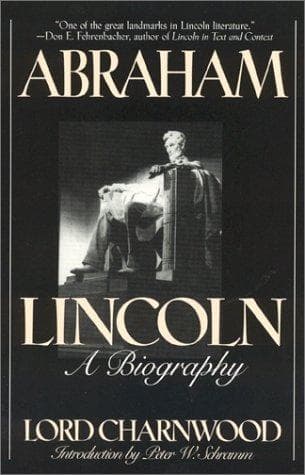
Abraham LincolnCharnwood, Godfrey Rathbone Benson, Baron
History
Abraham Lincoln
Charnwood, Godfrey Rathbone Benson, Baron
Lincoln, Abraham, 1809-1865; Presidents -- United States -- Biography
The Declaration of Independence was not a very candid State paper, and
the popularity Jefferson afterwards created for its sentiments was not
wholly free from humbug. Many men were more ready to think themselves
the equals of Washington or Hamilton in the respects in which they were
not so, than to think a negro their own equal in the respects in which he
was. The boundless space and untrammelled conditions of the new world
made liberty and equality in some directions highly attainable ideals, so
much so that they seemed to demand little effort or discipline. The
patriotic orators under whom Lincoln sat in his youth would ascribe to
the political wisdom of their great democracy what was really the result
of geography. They would regard the extent of forest and prairie as
creditable to themselves, just as some few Englishmen have regarded our
location upon an island.
This does not, however, do away with the value of that tradition of the
new world which in its purest and sincerest form became part and parcel
of Lincoln's mind. Jefferson was a great American patriot. In his case
insistence on the rights of the several States sprang from no
half-hearted desire for a great American nation; he regarded these
provincial organisations as machinery by which government and the people
could be brought nearer together; and he contributed that which was most
needed for the evolution of a vigorous national life. He imparted to the
very recent historical origin of his country, and his followers imparted
to its material conditions, a certain element of poetry and the felt
presence of a wholesome national ideal. The patriotism of an older
country derives its glory and its pride from influences deep rooted in
the past, creating a tradition of public and private action which needs
no definite formula. The man who did more than any other to supply this
lack in a new country, by imbuing its national consciousness--even its
national cant--with high aspiration, did--it may well be--more than any
strong administrator or constructive statesman to create a Union which
should thereafter seem worth preserving.
4. _The Missouri Compromise_.
Public-domain text, read in full here on John Shaqi.
Reviews
Reviews
No reviews yet
Be the first to share your thoughts on this work.
Join the Discussion
Join the discussion
Sign in to leave a comment or review.
Sign InorCreate an account