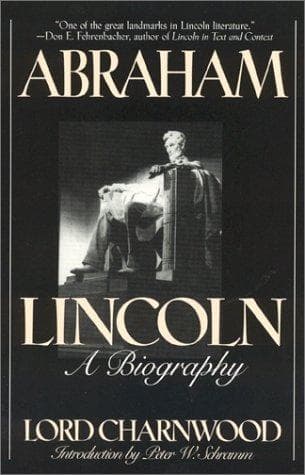
Abraham LincolnCharnwood, Godfrey Rathbone Benson, Baron
History
Abraham Lincoln
Charnwood, Godfrey Rathbone Benson, Baron
Lincoln, Abraham, 1809-1865; Presidents -- United States -- Biography
It must be added that wages in civil employment were very
high. Lincoln, it is evident, felt this apparent failure of patriotism
sadly, but in calm retrospect it cannot seem surprising.
In the latter part of 1862 attempts were made to use the powers of
compulsion which the several States possessed, under the antiquated laws
as to militia which existed in all of them, in order to supplement
recruiting. The number of men raised for short periods in this way is so
small that the description of the Northern armies at this time as purely
volunteer armies hardly needs qualification. It would probably be worth
no one's while to investigate the makeshift system with which the
Government, very properly, then tried to help itself out; for it speedily
and completely failed. The Conscription Act, which became law on March
3, 1863, set up for the first time an organisation for recruiting which
covered the whole country but was under the complete control of the
Federal Government. It was placed under an officer of great ability,
General J. B. Fry, formerly chief of staff to Buell, and now entitled
Provost-Marshal-General. It was his business, through provost-marshals
in a number of districts, each divisible into sub-districts as
convenience might require, to enroll all male citizens between twenty and
forty-five. He was to assign a quota, in other words a stated proportion
of the number of troops for which the Government might at any time call,
to each district, having regard to the number of previous enlistments
from each district. The management of voluntary enlistment was placed in
his hands, in order that the two methods of recruiting might be worked in
harmony. The system as a whole was quite distinct from any such system
of universal service as might have been set up beforehand in time of
peace. Compulsion only came into force in default of sufficient
volunteers from any district to provide its required number of the troops
wanted. When it came into force the "drafts" of conscripts were chosen
by lot from among those enrolled as liable for service. But there was a
way of escape from actual service. It seems, from what Lincoln wrote, to
have been looked upon as a time-honoured principle, established by
precedent in all countries, that the man on whom the lot fell might
provide a substitute if he could. The market price of a substitute (a
commodity for the provision of which a class of "substitute brokers" came
into being) proved to be about 1,000 dollars. Business or professional
men, who felt they could not be spared from home but wished to act
patriotically, did buy substitutes; but they need not have done so, for
the law contained a provision intended, as Lincoln recorded, to safeguard
poorer men against such a rise in prices. They could escape by paying
300 dollars, or 60 pounds, not, in the then state of wages, an
extravagant penalty upon an able-bodied man. The sums paid under this
Public-domain text, read in full here on John Shaqi.
Reviews
Reviews
No reviews yet
Be the first to share your thoughts on this work.
Elsewhere in the archive
Join the Discussion
Join the discussion
Sign in to leave a comment or review.
Sign InorCreate an account