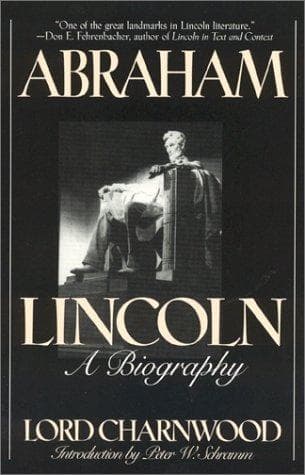
Abraham LincolnCharnwood, Godfrey Rathbone Benson, Baron
History
Abraham Lincoln
Charnwood, Godfrey Rathbone Benson, Baron
Lincoln, Abraham, 1809-1865; Presidents -- United States -- Biography
The constitutional validity of the law was much questioned by
politicians, but never finally tried out on appeal to the Supreme Court.
There seems to be no room for doubt that Lincoln's own reasoning on this
matter was sound. The Constitution simply gave to Congress "power to
raise and support armies," without a word as to the particular means to
be used for the purpose; the new and extremely well-considered
Constitution of the Confederacy was in this respect the same. The
Constitution, argued Lincoln, would not have given the power of raising
armies without one word as to the mode in which it was to be exercised,
if it had not meant Congress to be the sole judge as to the mode. "The
principle," he wrote, "of the draft, which simply is involuntary or
enforced service, is not new. It has been practised in all ages of the
world. It was well known to the framers of our Constitution as one of
the modes of raising armies. . . . It had been used just before, in
establishing our independence, and it was also used under the
Constitution in 1812." In fact, as we have seen, a certain power of
compelling military service existed in each of the States and had existed
in them from the first. Their ancestors had brought the principle with
them from the old country, in which the system of the "militia ballot"
had not fallen into desuetude when they became independent. The
traditional English jealousy, which the American Colonies had imbibed,
against the military power of the Crown had never manifested itself in
any objection to the means which might be taken to raise soldiers, but in
establishing a strict control of the number which the Crown could at any
moment maintain; and this control had long been in England and had always
been in America completely effective. We may therefore treat the protest
which was raised against the law as unconstitutional, and the companion
argument that it tended towards military despotism, as having belonged to
the realm of political verbiage, and as neither founded in reason nor
addressed to living popular emotions.
Public-domain text, read in full here on John Shaqi.
Reviews
Reviews
No reviews yet
Be the first to share your thoughts on this work.
Elsewhere in the archive
Join the Discussion
Join the discussion
Sign in to leave a comment or review.
Sign InorCreate an account