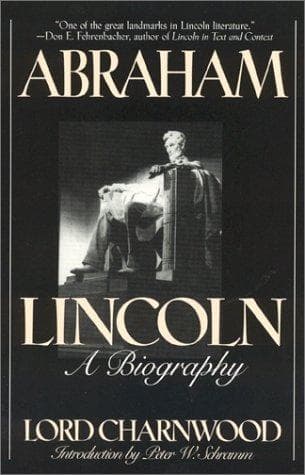
Abraham LincolnCharnwood, Godfrey Rathbone Benson, Baron
History
Abraham Lincoln
Charnwood, Godfrey Rathbone Benson, Baron
Lincoln, Abraham, 1809-1865; Presidents -- United States -- Biography
This is the way in which the Northern people, of whom a large part were,
it must be remembered, Democrats, seem to have regarded these
contentions, and a real sense, apart from these contentions, that
conscription was unnecessary or produced avoidable hardship seems
scarcely to have existed. It was probably for this reason that Lincoln
never published the address to the people, or perhaps more particularly
to the Democratic opposition, to which several references have already
been made. In the course of it he said: "At the beginning of the war,
and ever since, a variety of motives, pressing, some in one direction and
some in the other, would be presented to the mind of each man physically
fit to be a soldier, upon the combined effect of which motives he would,
or would not, voluntarily enter the service. Among these motives would
be patriotism, political bias, ambition, personal courage, love of
adventure, want of employment, and convenience, or the opposite of some
of these. We already have and have had in the service, as it appears,
substantially all that can be obtained upon this voluntary weighing of
motives. And yet we must somehow obtain more or relinquish the original
object of the contest, together with all the blood and treasure already
expended in the effort to secure it. To meet this necessity the law for
the draft has been enacted. You who do not wish to be soldiers do not
like this law. This is natural; nor does it imply want of patriotism.
Nothing can be so just and necessary as to make us like it if it is
disagreeable to us. We are prone, too, to find false arguments with
which to excuse ourselves for opposing such disagreeable things." He
proceeded to meet some of these arguments upon the lines which have
already been indicated. After speaking of the precedents for
conscription in America, he continued: "Wherein is the peculiar hardship
now? Shall we shrink from the necessary means to maintain our free
government, which our grandfathers employed to establish it and our
fathers have already once employed to maintain it? Are we degenerate?
Has the manhood of our race run out?" Unfair administration was
apprehended. "This law," he said, "belongs to a class, which class is
composed of those laws whose object is to distribute burthens or benefits
on the principle of equality. No one of these laws can ever be
practically administered with that exactness which can be conceived of in
the mind. A tax law . . . will be a dead letter if no one will be
compelled to pay until it can be shown that every other one will be
compelled to pay in precisely the same proportion according to value;
nay, even it will be a dead letter if no one can be compelled to pay
until it is certain that every other one will pay at all. . . . This
sort of difficulty applies in full force to the practical administration
of the draft law. In fact, the difficulty is greater in the case of the
draft law"; and he proceeded to state the difficulties.
Public-domain text, read in full here on John Shaqi.
Reviews
Reviews
No reviews yet
Be the first to share your thoughts on this work.
Elsewhere in the archive
Join the Discussion
Join the discussion
Sign in to leave a comment or review.
Sign InorCreate an account