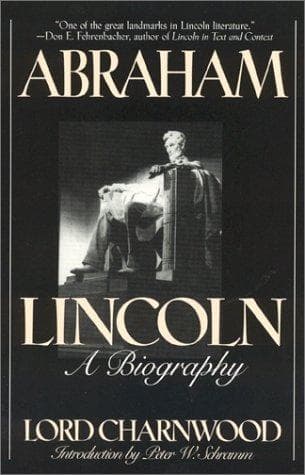
Abraham LincolnCharnwood, Godfrey Rathbone Benson, Baron
History
Abraham Lincoln
Charnwood, Godfrey Rathbone Benson, Baron
Lincoln, Abraham, 1809-1865; Presidents -- United States -- Biography
whether the wicked Government might not become more odious than the
enemy. There arose, too, as there often arises in war time, a fraternal
feeling between men who hated the war and men who reflected how much
better they could have if waged it themselves.
There was, of course, much in the conduct of the Government which called
for criticism, and on that account it was a grievous pity that
independence should have stultified itself by reviving in any form the
root principle of party government, and recognising as the best critics
of the Administration men who desired to take its place. More useful
censure of the Government at that time might have come from men who, if
they had axes to grind, would have publicly thrown them away. There were
two points which especially called for criticism, apart from military
administration, upon which, as it happened, Lincoln knew more than his
critics knew and more than he could say. One of these points was
extravagance and corruption in the matter of army contracts and the like;
these evils were dangerously prevalent, but members of the Cabinet were
as anxious to prevent them as any outside critic could be, and it was
friendly help, not censure, that was required. The other point was the
exercise of martial law, a difficult question, upon which a word must
here be said, but upon which only those could usefully have spoken out
whose general support of the Government was pronounced and sincere.
In almost every rebellion or civil war statesmen and the military
officers under them are confronted with the need, for the sake of the
public safety or even of ordinary justice, of rules and procedure which
the law in peace time would abhor. In great conflicts, such as our own
wars after the French Revolution and the American Civil War, statesmen
such as Pitt and Lincoln, capable of handling such a problem well, have
had their hands full of yet more urgent matters. The puzzling part of
the problem does not lie in the neighbourhood of the actual fighting,
where for the moment there can be no law but the will of the commander,
but in the districts more distantly affected, or in the period when the
war is smouldering out. Lincoln's Government had at first to guard
itself against dangerous plots which could be scented but not proved in
Washington; later on it had to answer such questions as this: What should
be done when a suspected agent of the enemy is vaguely seen to be working
against enlistment, when an attack by the civil mob upon the recruits is
likely to result, and when the local magistrate and police are not much
to be trusted? There is no doubt that Seward at the beginning, and
Stanton persistently, and zealous local commanders now and then solved
such problems in a very hasty fashion, or that Lincoln throughout was far
more anxious to stand by vigorous agents of the Government than to
correct them.
Public-domain text, read in full here on John Shaqi.
Reviews
Reviews
No reviews yet
Be the first to share your thoughts on this work.
Elsewhere in the archive
Join the Discussion
Join the discussion
Sign in to leave a comment or review.
Sign InorCreate an account