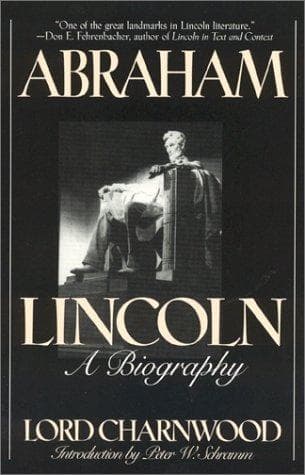
Abraham LincolnCharnwood, Godfrey Rathbone Benson, Baron
History
Abraham Lincoln
Charnwood, Godfrey Rathbone Benson, Baron
Lincoln, Abraham, 1809-1865; Presidents -- United States -- Biography
"In all these
points," he continued, "errors will occur in spite of the utmost
fidelity. The Government is bound to administer the law with such an
approach to exactness as is usual in analogous cases, and as entire good
faith and fidelity will reach." Errors, capable of correction, should,
he promised, be corrected when pointed out; but he concluded: "With these
views and on these principles, I feel bound to tell you it is my purpose
to see the draft law faithfully executed." It was his way, as has been
seen, sometimes to set his thoughts very plainly on paper and to consider
afterwards the wisdom of publishing them. This paper never saw the light
till after his death. It is said that some scruple as to the custom in
his office restrained him from sending it out, but this scruple probably
weighed with him the more because he saw that the sincere people whom he
had thought of addressing needed no such appeal. It was surely a wise
man who, writing so wisely, could see the greater wisdom of silence.
The opposition to the Conscription Law may be treated simply as one
element in the propaganda of the official Opposition to the
Administration. The opposition to such a measure which we might possibly
have expected to arise from churches, or from schools of thought
independent of the ordinary parties, does not seem, as a matter of fact,
to have arisen. The Democratic party had, as we have seen, revived in
force in the latter part of 1862. Persons, ambitious, from whatever
mixture of motives, of figuring as leaders of opposition during a war
which they did not condemn, found a public to which to appeal, mainly
because the war was not going well. They found a principle of opposition
satisfactory to themselves in condemning the Proclamation of
Emancipation. (It was significant that McClellan shortly after the
Proclamation issued a General Order enjoining obedience to the Government
and adding the hint that "the remedy for political errors, if any are
committed, is to be found only in the action of the people at the
polls.") In the curious creed which respectable men, with whom
allegiance to an ancient party could be a powerful motive at such a time,
were driven to construct for themselves, enforcement of the duty to
defend the country and liberation of the enemy's slaves appeared as twin
offences against the sacred principles of constitutional freedom. It
would have been monstrous to say that most of the Democrats were opposed
to the war. Though a considerable number had always disliked it and now
found courage to speak loudly, the bulk were as loyal to the Union as
those very strong Republicans like Greeley, who later on despaired of
maintaining it. But there were naturally Democrats for whom a chance now
appeared in politics, and who possessed that common type of political
mind that meditates deeply on minor issues and is inflamed by zeal
against minor evils. Such men began to debate with their consciences
Public-domain text, read in full here on John Shaqi.
Reviews
Reviews
No reviews yet
Be the first to share your thoughts on this work.
Elsewhere in the archive
Join the Discussion
Join the discussion
Sign in to leave a comment or review.
Sign InorCreate an account