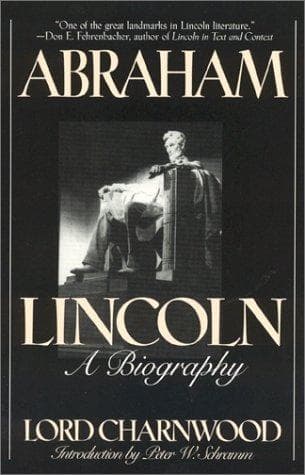
Abraham LincolnCharnwood, Godfrey Rathbone Benson, Baron
History
Abraham Lincoln
Charnwood, Godfrey Rathbone Benson, Baron
Lincoln, Abraham, 1809-1865; Presidents -- United States -- Biography
These were indeed kinds of action with which Lincoln thought
ordinary Courts of justice "utterly incompetent" to deal, and he avowed
that he aimed rather at preventing intended actions than at punishing
them when done. To some minds this will seem to be an attitude dangerous
to liberty, but he was surely justified when he said, "In such cases the
purposes of men are much more easily understood than in cases of ordinary
crime. The man who stands by and says nothing when the peril of his
Government is discussed cannot be misunderstood. If not hindered, he is
sure to help the enemy, much more if he talks ambiguously--talks for his
country with 'buts' and 'ifs' and 'ands.'" In any case, Lincoln stood
clearly and boldly for repressing speech or act, that could help the
enemy, with extreme vigour and total disregard for the legalities of
peace time. A little later on we shall see fully whether this imported
on his part any touch whatever of the ferocity which it may seem to
suggest.
The Democratic opposition which made some headway in the first half of
1863 comprised a more extreme opposition prevailing in the West and led
by Clement Vallandigham, a Congressman from Ohio, and a milder opposition
led by Horatio Seymour, who from the end of 1862 to the end of 1864, when
he failed of re-election, was Governor of New York State. The extreme
section were often called "Copperheads," after a venomous snake of that
name. Strictly, perhaps, this political term should be limited to the
few who went so far as to desire the victory of the South; more loosely
it was applied to a far larger number who went no further than to say
that the war should be stopped. This demand, it must be observed, was
based upon the change of policy shown in the Proclamation of
Emancipation. "The war for the Union," said Vallandigham in Congress in
January, 1863, "is in your hands a most bloody and costly failure. War
for the Union was abandoned; war for the negro openly begun. With what
success? Let the dead at Fredericksburg answer.--Ought this war to
continue? I answer no--not a day, not an hour. What then? Shall we
separate? Again I answer, no, no, no.--Stop fighting. Make an
armistice. Accept at once friendly foreign mediation." And further:
"The secret but real purpose of the war was to abolish slavery in the
States, and with it the change of our present democratical form of
government into an imperial despotism." This was in no sense treason; it
was merely humbug. The alleged design to establish despotism, chiefly
revealed at that moment by the liberation of slaves, had of course no
existence. Equally false, as will be seen later, was the whole
suggestion that any peace could have been had with the South except on
the terms of separation. Vallandigham, a demagogue of real vigour, had
perhaps so much honesty as is compatible with self-deception; at any
rate, upon his subsequent visit to the South his intercourse with
Public-domain text, read in full here on John Shaqi.
Reviews
Reviews
No reviews yet
Be the first to share your thoughts on this work.
Elsewhere in the archive
Join the Discussion
Join the discussion
Sign in to leave a comment or review.
Sign InorCreate an account