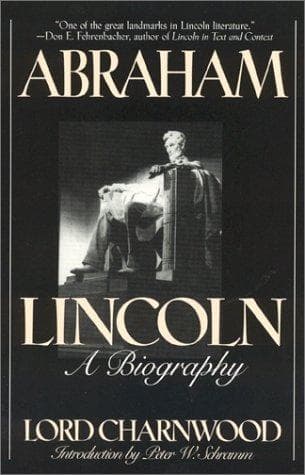
Abraham LincolnCharnwood, Godfrey Rathbone Benson, Baron
History
Abraham Lincoln
Charnwood, Godfrey Rathbone Benson, Baron
Lincoln, Abraham, 1809-1865; Presidents -- United States -- Biography
Governor Seymour was a more presentable antagonist than Vallandigham. He
did not propose to stop the war. On the contrary, his case was that the
war could only be effectively carried on by a law-abiding Government,
which would unite the people by maintaining the Constitution, not, as the
Radicals argued, by the flagitious policy of freeing the slaves. It
should be added that he was really concerned at the corruption which was
becoming rife, for which war contracts gave some scope, and which, with a
critic's obliviousness to the limitations of a human force, he thought
the most heavily-burdened Administration of its time could easily have
put down. With a little imagination it is easy to understand the
difficult position of the orthodox Democrats, who two years before had
voted against restricting the extension of slavery, and were now asked
for the sake of the Union to support a Government which was actually
abolishing slavery by martial law. Also the attitude of the thoroughly
self-righteous partisan is perfectly usual. Many of Governor Seymour's
utterances were fair enough, and much of his conduct was patriotic
enough. His main proceedings can be briefly summarised. His election as
Governor in the end of 1862 was regarded as an important event, the
appearance of a new leader holding an office of the greatest influence.
Lincoln, assuming, as he had a right to do, the full willingness of
Seymour to co-operate in prosecuting the war, did the simplest and best
thing. He wrote and invited Seymour after his inauguration in March,
1863, to a personal conference with himself as to the ways in which, with
their divergent views, they could best co-operate. The Governor waited
three weeks before he acknowledged this letter. He then wrote and
promised a full reply later. He never sent this reply. He protested
energetically and firmly against the arrest of Vallandigham. In July,
1863, the Conscription Act began to be put in force in New York city;
then occurred the only serious trouble that ever did occur under the Act;
and it was very serious. A mob of foreign immigrants, mainly Irish, put
a forcible stop to the proceeding of the draft. It set fire to the
houses of prominent Republicans, and prevented the fire brigade from
saving them. It gave chase to all negroes that it met, beating some to
death, stringing up others to trees and lamp-posts and burning them as
they hung. It burned down an orphanage for coloured children after the
police had with difficulty saved its helpless inmates. Four days of
rioting prevailed throughout the city before the arrival of fresh troops
restored order. After an interval of prudent length the draft was
successfully carried out. Governor Seymour arrived in the city during
the riots. He harangued this defiled mob in gentle terms, promising
them, if they would be good, to help them in securing redress of the
grievance to which he attributed their conduct. Thenceforward to the end
Public-domain text, read in full here on John Shaqi.
Reviews
Reviews
No reviews yet
Be the first to share your thoughts on this work.
Elsewhere in the archive
Join the Discussion
Join the discussion
Sign in to leave a comment or review.
Sign InorCreate an account