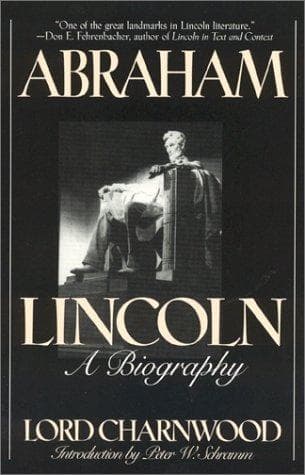
Abraham LincolnCharnwood, Godfrey Rathbone Benson, Baron
History
Abraham Lincoln
Charnwood, Godfrey Rathbone Benson, Baron
Lincoln, Abraham, 1809-1865; Presidents -- United States -- Biography
It is the general military opinion that before the war entered on its
final stage Jefferson Davis should have concentrated all his forces for a
larger invasion of the North than was ever in fact undertaken. In the
Gettysburg campaign he might have strengthened Lee's army by 20,000 men
if he could have withdrawn them from the forts at Charleston.
Charleston, however, was threatened during 1863 by the sea and land
forces of the North, in an expedition which was probably itself unwise,
as Lincoln himself seems to have suspected, but which helped to divert a
Confederate army. In the beginning of 1864 Davis still kept this force
at Charleston; he persisted also in keeping a hold on his own State,
Mississippi, with a further small army; while Longstreet still remained
in the south-east corner of Tennessee, where a useful employment of his
force was contemplated but none was made. The chief Southern armies with
which we have to deal are that of Lee, lying south of the Rapidan, and
that of Bragg, now superseded by Joseph Johnston, at Dalton, south of
Chattanooga. The Confederacy, it is thought, was now in a position in
which it might take long to reduce it, but the only military chance for
it was concentration on one great counter-stroke. This seems to have
been the opinion of Lee and Longstreet. Jefferson Davis clung, even late
in the year 1864, to the belief that disaster must somehow overtake any
invading Northern army which pushed far. Possibly he reckoned also that
the North would weary of the repeated checks in the process of conquest.
Indeed, as will be seen later, the North came near to doing so, while a
serious invasion of the North, unless overwhelmingly successful, might
really have revived its spirit. In any case Jefferson Davis, unlike
Lincoln, had no desire to be guided by his best officers. He was for
ever quarrelling with Joseph Johnston and often with Beauregard; the less
capable Bragg, though removed from the West, was now installed as his
chief adviser in Richmond; and the genius of Lee was not encouraged to
apply itself to the larger strategy of the war.
Public-domain text, read in full here on John Shaqi.
Reviews
Reviews
No reviews yet
Be the first to share your thoughts on this work.
Elsewhere in the archive
Join the Discussion
Join the discussion
Sign in to leave a comment or review.
Sign InorCreate an account