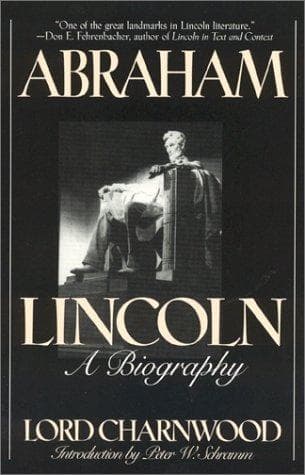
Abraham LincolnCharnwood, Godfrey Rathbone Benson, Baron
History
Abraham Lincoln
Charnwood, Godfrey Rathbone Benson, Baron
Lincoln, Abraham, 1809-1865; Presidents -- United States -- Biography
At the beginning of 1864 an advance from Chattanooga southward into the
heart of the Confederate country was in contemplation. Grant and
Farragut wished that it should be supported by a joint military and naval
attack upon Mobile, in Alabama, on the Gulf of Mexico. Other
considerations on the part of the Government prevented this. In 1863
Marshal Bazaine had invaded Mexico to set up Louis Napoleon's ill-fated
client the Archduke Maximilian as Emperor. As the so-called "Monroe
Doctrine" (really attributable to the teaching of Hamilton and the action
of John Quincy Adams, who was Secretary of State under President Monroe)
declared, such an extension of European influence, more especially
dynastic influence, on the American continent was highly unacceptable to
the United States. Many in the North were much excited, so much so that
during 1864 a preposterous resolution, which meant, if anything, war with
France, was passed on the motion of one Henry Winter Davis. It was of
course the business of Lincoln and of Seward, now moulded to his views,
to avoid this disaster, and yet, with such dignity as the situation
allowed, keep the French Government aware of the enmity which they might
one day incur. They did this. But they apprehended that the French,
with a footing for the moment in Mexico, had designs on Texas; and thus,
though the Southern forces in Texas were cut off from the rest of the
Confederacy and there was no haste for subduing them, it was thought
expedient, with an eye on France, to assert the interest of the Union in
Texas. General Banks, in Louisiana, was sent to Texas with the forces
which would otherwise have been sent to Mobile. His various endeavours
ended in May, 1864, with the serious defeat of an expedition up the Red
River. This defeat gave great annoyance to the North and made an end of
Banks' reputation. It might conceivably have had a calamitous sequel in
the capture by the South of Admiral Porter's river flotilla, which
accompanied Banks, and the consequent undoing of the conquest of the
Mississippi. As it was it wasted much force.
Before Grant could safely launch his forces southward from Chattanooga
against Johnston, it was necessary to deal in some way with the
Confederate force still at large in Mississippi. Grant determined to do
this by the destruction of the railway system by which alone it could
move eastward. For this purpose he left Thomas to hold Chattanooga,
while Sherman was sent to Meridian, the chief railway centre in the
Southern part of Mississippi. In February Sherman arrived there, and,
though a subsidiary force, sent from Memphis on a similar but less
important errand somewhat further north, met with a severe repulse, he
was able unmolested to do such damage to the lines around Meridian as to
secure Grant's purpose.
Public-domain text, read in full here on John Shaqi.
Reviews
Reviews
No reviews yet
Be the first to share your thoughts on this work.
Elsewhere in the archive
Join the Discussion
Join the discussion
Sign in to leave a comment or review.
Sign InorCreate an account