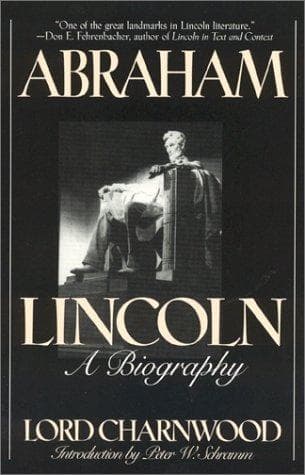
Abraham LincolnCharnwood, Godfrey Rathbone Benson, Baron
History
Abraham Lincoln
Charnwood, Godfrey Rathbone Benson, Baron
Lincoln, Abraham, 1809-1865; Presidents -- United States -- Biography
You are vigilant and self-reliant, and, pleased with this, I wish
not to obtrude any constraints or restraints upon you. While I am very
anxious that any great disaster or capture of our men in great numbers
shall be avoided, I know these points are less likely to escape your
attention than they would be mine. If there is anything wanting which is
within my power to give, do not fail to let me know it. And now, with a
brave army and a just cause, may God sustain you." Grant replied: "From
my first entrance into the volunteer service of the country to the
present day I have never had cause of complaint--have never expressed or
implied a complaint against the Administration, or the Secretary of War,
for throwing any embarrassment in the way of my vigorously prosecuting
what appeared to me my duty. Indeed, since the promotion which placed me
in command of all the armies, and in view of the great responsibility and
importance of success, I have been astonished at the readiness with which
everything asked for has been yielded, without even an explanation being
asked. Should my success be less than I desire or expect, the least I
can say is, the fault is not with you." At this point the real
responsibility of Lincoln in regard to military events became
comparatively small, and to the end of the war those events may be traced
with even less detail than has hitherto been necessary.
Upon joining the Army of the Potomac Grant retained Meade, with whom he
was pleased, in a somewhat anomalous position under him as commander of
that army. "Wherever Lee goes," he told him, "there you will go too."
His object of attack was, in agreement with the opinion which Lincoln had
from an early date formed, Lee's army. If Lee could be compelled, or
should choose, to shut himself up in Richmond, as did happen, then
Richmond would become an object of attack, but not otherwise. Grant,
however, hoped that he might force Lee to give him battle in the open.
In the open or behind entrenchments, he meant to fight him, reckoning
that if he lost double the number that Lee did, his own loss could easily
be made up, but Lee's would be irreparable. His hope was to a large
extent disappointed. He had to do with a greater general than himself,
who, with his men, knew every inch of a tangled country. In the
engagements which now followed, Grant's men were constantly being hurled
against chosen positions, entrenched and with the new device of wire
entanglements in front of them. "I mean," he wrote, "to fight it out on
this line if it takes all summer." It took summer, autumn, winter, and
the early spring. Once across the Rapidan he was in the tract of scrubby
jungle called the Wilderness. He had hoped to escape out of this
unopposed and at the same time to turn Lee's right by a rapid march to
his own left. But he found Lee in his way. On May 5 and 6 there was
stubborn and indecisive fighting, with a loss to Grant of 17,660 and to
Public-domain text, read in full here on John Shaqi.
Reviews
Reviews
No reviews yet
Be the first to share your thoughts on this work.
Elsewhere in the archive
Join the Discussion
Join the discussion
Sign in to leave a comment or review.
Sign InorCreate an account