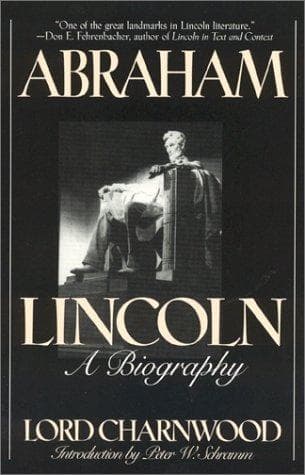
Abraham LincolnCharnwood, Godfrey Rathbone Benson, Baron
History
Abraham Lincoln
Charnwood, Godfrey Rathbone Benson, Baron
Lincoln, Abraham, 1809-1865; Presidents -- United States -- Biography
There was yet a further preliminary to the great final struggle. On
March 1, 1864, pursuant to an Act of Congress which was necessary for
this object, Lincoln conferred upon Grant the rank of Lieutenant-General,
never held by any one else since Washington, for it was only brevet rank
that was conferred on Scott. Therewith Grant took the command, under the
President, of all the Northern armies. Grant came to Washington to
receive his new honour. He had taken leave of Sherman in an interchange
of letters which it is good to read; but he had intended to return to the
West. Sherman, who might have desired the command in the West for
himself, had unselfishly pressed him to return. He feared that the
dreaded politicians would in some way hurt Grant, and that he would be
thwarted by them, become disgusted, and retire; they did hurt him, but
not then, nor in the way that Sherman had expected. Grant, however,
could trust Sherman to carry out the work he wanted done in the West, and
he now saw that, as Lincoln might have told him and possibly did, the
work he wanted done in the East must be done by him. He went West again
for a few days only, to settle his plans with Sherman. Sherman with his
army of 100,000 was to follow Johnston's army of about 60,000, wherever
it went, till he destroyed it. Grant with his 120,000 was to keep up an
equally unfaltering fight with Lee's army, also of 60,000. There was, of
course, nothing original about this conception except the idea, fully
present to both men's minds, of the risk and sacrifice with which it was
worth while to carry it out. Lincoln and Grant had never met till this
month. Grant at the first encounter was evidently somewhat on his guard.
He was prepared to like Lincoln, but he was afraid of mistaken dictation
from him, and determined to discourage it. Also Stanton had advised him
that Lincoln, out of mere good nature, would talk unwisely of any plans
discussed with him. This was probably quite unjust. Stanton, in order
to keep politicians and officers in their places, was accustomed to bite
off the noses of all comers. Lincoln, on the contrary, would talk to all
sorts of people with a readiness which was sometimes astonishing, but
there was a good deal of method in this--he learnt something from these
people all the time--and he certainly had a very great power of keeping
his own counsel when he chose. In any case, when Grant at the end of
April left Washington for the front, he parted with Lincoln on terms of
mutual trust which never afterwards varied. Lincoln in fact, satisfied
as to his general purpose, had been happy to leave him to make his plans
for himself. He wrote to Grant: "Not expecting to see you again before
the spring campaign begins, I wish to express in this way my entire
satisfaction with what you have done up to this time so far as I
understand it. The particulars of your plan I neither know nor seek to
know.
Public-domain text, read in full here on John Shaqi.
Reviews
Reviews
No reviews yet
Be the first to share your thoughts on this work.
Elsewhere in the archive
Join the Discussion
Join the discussion
Sign in to leave a comment or review.
Sign InorCreate an account