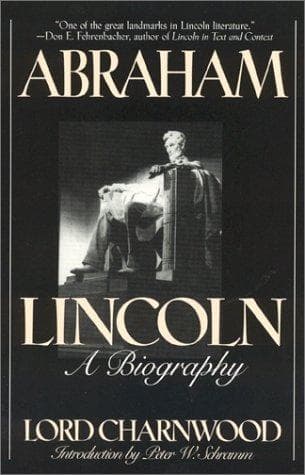
Abraham LincolnCharnwood, Godfrey Rathbone Benson, Baron
History
Abraham Lincoln
Charnwood, Godfrey Rathbone Benson, Baron
Lincoln, Abraham, 1809-1865; Presidents -- United States -- Biography
It was not given to Lincoln after all to play a great part in the
reconstruction of the South; that was reserved for much rougher and much
weaker hands. But the lines on which he had moved from the first are of
interest. West Virginia, with its solid Unionist population, was simply
allowed to form itself into an ordinary new State. But matters were not
so simple where the Northern occupation was insecure, or where a tiny
fraction of a State was held, or where a large part of the people leaned
to the Confederacy. Military governors were of course appointed; in
Tennessee this position was given to a strong Unionist, Andrew Johnson,
who was already Senator for that State. In Louisiana and elsewhere
Lincoln encouraged the citizens who would unreservedly accept the Union
to organise State Governments for themselves. Where they did so there
was friction between them and the Northern military governor who was
still indispensable. There was also to the end triangular trouble
between the factions in Missouri and the general commanding there. To
these little difficulties, which were of course unceasing, Lincoln
applied the firmness and tact which were no longer surprising in him,
with a pleasing mixture of good temper and healthy irritation. But
further difficulties lay in the attitude of Congress, which was concerned
in the matter because each House could admit or reject the Senators or
Representatives claiming to sit for a Southern State. There were
questions about slavery in such States. Lincoln, as we have seen, had
desired, if he could, to bring about the abolition of slavery through
gradual and through local action, and he had wished to see the franchise
given only to the few educated negroes. Nothing came of this, but it
kept up the suspicion of Radicals in Congress that he was not sound on
slavery; and, apart from slavery, the whole question of the terms on
which people lately in arms against the country could be admitted as
participators in the government of the country was one on which statesmen
in Congress had their own very important point of view. Lincoln's main
wish was that, with the greatest speed and the least heat spent on
avoidable controversy, State government of spontaneous local growth
should spring up in the reconquered South. "In all available ways," he
had written to one of his military governors, "give the people a chance
to express their wishes at these elections. Follow forms of law as far
as convenient, but at all events get the expression of the largest number
of people possible." Above all he was afraid lest in the Southern
elections to Congress that very thing should happen which after his death
did happen. "To send a parcel of Northern men here as representatives,
elected, as would be understood (and perhaps really so), at the point of
the bayonet, would be disgraceful and outrageous." For a time he and
Congress worked together well enough, but sharp disagreement arose in
1864.
Public-domain text, read in full here on John Shaqi.
Reviews
Reviews
No reviews yet
Be the first to share your thoughts on this work.
Elsewhere in the archive
Join the Discussion
Join the discussion
Sign in to leave a comment or review.
Sign InorCreate an account