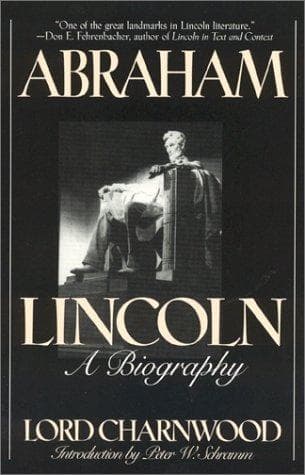
Abraham LincolnCharnwood, Godfrey Rathbone Benson, Baron
History
Abraham Lincoln
Charnwood, Godfrey Rathbone Benson, Baron
Lincoln, Abraham, 1809-1865; Presidents -- United States -- Biography
He had propounded a particular plan for the reconstruction of
Southern States. Senator Wade, the formidable Chairman of the Joint
Committee on the War, and Henry Winter Davis, a keen, acrid, and fluent
man who was powerful with the House, carried a Bill under which a State
could only be reconstructed on their own plan, which differed from
Lincoln's. The Bill came to Lincoln for signature in the last hours of
the session, and, amidst frightened protests from friendly legislators
then in his room, he let it lie there unsigned, till it expired with the
session, and went on with his work. This was in July, 1864; his
re-election was at stake. The Democrats were gaining ground; he might be
giving extreme offence to the strongest Republican. "If they choose," he
said, "to make a point of this I do not doubt that they can do harm"
(indeed, those powerful men Wade and Davis now declared against his
re-election with ability and extraordinary bitterness); but he continued:
"At all events I must keep some consciousness of being somewhere near
right. I must keep some standard or principle fixed within myself." The
Bill would have repressed loyal efforts already made to establish State
Governments in the South. It contained also a provision imposing the
abolition of slavery on every such reconstructed State. This was an
attempt to remedy any flaw in the constitutional effect of the
Proclamation of Emancipation. But it was certainly in itself flagrantly
unconstitutional; and the only conclusive way of abolishing slavery was
the Constitutional Amendment, for which Lincoln was now anxious. This
was not a pedantic point, for there might have been great trouble if the
courts had later found a constitutional flaw in some negro's title to
freedom. But the correctness of Lincoln's view hardly matters. In lots
of little things, like a tired man who was careless by nature, Lincoln
may perhaps have yielded to influence or acted for his political
convenience in ways which may justly be censured, but it would be merely
immoral to care whether he did so or did not, since at the crisis of his
fate he could risk all for one scruple. In an earlier stage of his
controversies with the parties he had written: "From time to time I have
done and said what appeared to me proper to do and say. The public knows
it all. It obliges nobody to follow me, and I trust it obliges me to
follow nobody. The Radicals and Conservatives each agree with me in some
things and disagree in others. I could wish both to agree with me in all
things; for then they would agree with each other, and be too strong for
any foe from any quarter. They, however, choose to do otherwise, and I
do not question their right. I, too, shall do what seems to be my duty.
I hold whoever commands in Missouri or elsewhere responsible to me and
not to either Radicals or Conservatives. It is my duty to hear all; but
at last I must, within my sphere, judge what to do and what to forbear."
Public-domain text, read in full here on John Shaqi.
Reviews
Reviews
No reviews yet
Be the first to share your thoughts on this work.
Elsewhere in the archive
Join the Discussion
Join the discussion
Sign in to leave a comment or review.
Sign InorCreate an account