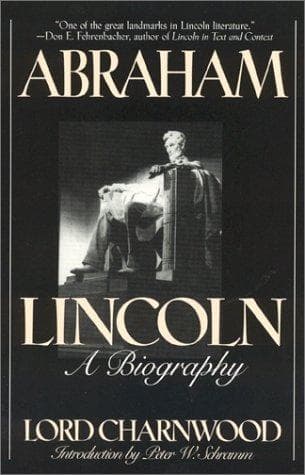
Abraham LincolnCharnwood, Godfrey Rathbone Benson, Baron
History
Abraham Lincoln
Charnwood, Godfrey Rathbone Benson, Baron
Lincoln, Abraham, 1809-1865; Presidents -- United States -- Biography
In this same month of July, after the Confederate General Early's
appearance before Washington had given Lincoln a pause from political
cares, another trouble reached a point at which it is known to have tried
his patience more than any other trouble of his Presidency. Peace after
war is not always a matter of substituting the diplomatist for the
soldier. When two sides were fighting, one for Union and the other for
Independence, one or the other had to surrender the whole point at issue.
In this case there might appear to have been a third possibility. The
Southern States might have been invited to return to the Union on terms
which admitted their right to secede again if they felt aggrieved. The
invitation would in fact have been refused. But, if it had been made and
accepted, this would have been a worse surrender for the North than any
mere acknowledgment that the South could not be reconquered; for national
unity from that day to this would have existed on the sufferance of a
factious or a foreign majority in any single State. Lincoln had faced
this. He was there to restore the Union on a firm foundation. He meant
to insist to the point of pedantry that, by not so much as a word or line
from the President or any one seeming to act for him, should the lawful
right of secession even appear to be acknowledged. Some men would have
been glad to hang Jefferson Davis as a traitor, yet would have been ready
to negotiate with him as with a foreign king. Lincoln, who would not
have hurt one hair of his head, and would have talked things over with
Mr. Davis quite pleasantly, would have died rather than treat with him on
the footing that he was head of an independent Confederacy. The blood
shed might have been shed for nothing if he had done so. But to many
men, in the long agony of the war and its disappointments, the plain
position became much obscured. The idea in various forms that by some
sort of negotiation the issue could be evaded began to assert itself
again and again. The delusion was freely propagated that the South was
ready to give in if only Lincoln would encourage its approaches. It was
sheer delusion. Jefferson Davis said frankly to the last that the
Confederacy would have "independence or extermination," and though
Stephens and many others spoke of peace to the electors in their own
States, Jefferson Davis had his army with him, and the only result which
agitation against him ever produced was that two months before the
irreparable collapse the chief command under him was given to his most
faithful servant Lee. But it was useless for Lincoln to expose the
delusion in the plainest terms; it survived exposure and became a danger
to Northern unity.
Public-domain text, read in full here on John Shaqi.
Reviews
Reviews
No reviews yet
Be the first to share your thoughts on this work.
Elsewhere in the archive
Join the Discussion
Join the discussion
Sign in to leave a comment or review.
Sign InorCreate an account