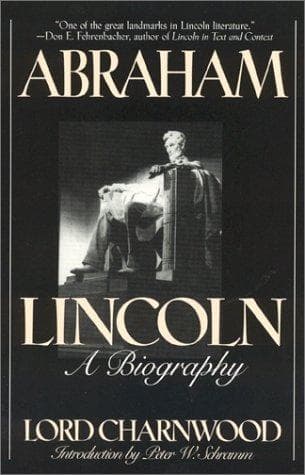
Abraham LincolnCharnwood, Godfrey Rathbone Benson, Baron
History
Abraham Lincoln
Charnwood, Godfrey Rathbone Benson, Baron
Lincoln, Abraham, 1809-1865; Presidents -- United States -- Biography
This man was a Radical, and known as the successor of Jefferson, but his
Radicalism showed itself in drawing inspiration solely from the popular
catchwords of his own locality. He adored the Union, but it was to be a
Union directed by distinguished politicians from the South in a sectional
Southern interest. He did not originate, but he secured the strength of
orthodoxy and fashion to a tone of sentiment and opinion which for a
generation held undisputed supremacy in the heart of the South.
Americans might have seemed at this time to be united in a curiously
exultant national self-consciousness, but though there was no sharp
division of sections, the boasted glory of the one America meant to many
planters in the South the glory of their own settled and free life with
their dignified equals round them and their often contented dependents
under them. Plain men among them doubtless took things as they were,
and, without any particular wish to change them, did not pretend they
were perfect. But it is evident that in a widening circle of clever
young men in the South the claim of some peculiar virtue for Southern
institutions became habitual in the first half of the nineteenth century.
Their way of life was beautiful in their eyes. It rested upon slavery.
Therefore slavery was a good thing. It was wicked even to criticise it,
and it was weak to apologise for it or to pretend that it needed
reformation. It was easy and it became apparently universal for the
different Churches of the South to prostitute the Word of God in this
cause. Later on crude notions of evolution began to get about in a few
circles of advanced thought, and these lent themselves as easily to the
same purpose. Loose, floating thoughts of this kind might have mattered
little. Calhoun, as the recognised wise man of the old South,
concentrated them and fastened them upon its people as a creed.
Glorification of "our institution at the South" became the main principle
of Southern politicians, and any conception that there may ever have been
of a task for constructive statesmanship, in solving the negro problem,
passed into oblivion under the influence of his revered reasoning faculty.
Public-domain text, read in full here on John Shaqi.
Reviews
Reviews
No reviews yet
Be the first to share your thoughts on this work.
Join the Discussion
Join the discussion
Sign in to leave a comment or review.
Sign InorCreate an account