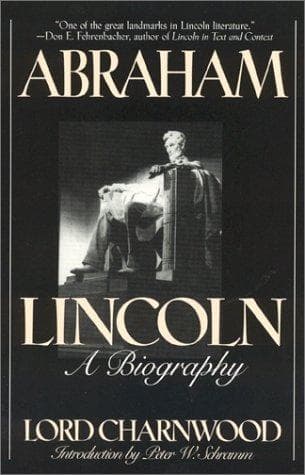
Abraham LincolnCharnwood, Godfrey Rathbone Benson, Baron
History
Abraham Lincoln
Charnwood, Godfrey Rathbone Benson, Baron
Lincoln, Abraham, 1809-1865; Presidents -- United States -- Biography
Sarah Bush Lincoln, his stepmother, was good to him and he to her.
Above all she encouraged him in his early studies, to which a fretful
housewife could have opposed such terrible obstacles. She lived to
hope that he might not be elected President for fear that enemies
should kill him, and she lived to have her fear fulfilled. His
affectionate care over her continued to the end. She lived latterly
with her son John Johnston. Abraham's later letters to this companion
of his youth deserve to be looked up in the eight large volumes called
his Works, for it is hard to see how a man could speak or act better to
an impecunious friend who would not face his own troubles squarely. It
is sad that the "ever your affectionate brother" of the earlier letters
declines to "yours sincerely" in the last; but it is an honest decline
of affection, for the man had proved to be cheating his mother, and
Abraham had had to stop it.
Two of the cousinhood, Dennis Hanks, a character of comedy, and John
Hanks, the serious and steady character of the connection, deserve
mention. They and John Johnston make momentary reappearances again.
Otherwise the whole of Abraham Lincoln's kindred are now out of the
story. They have been disposed of thus hastily at the outset, not
because they were discreditable or slight people, but because Lincoln
himself when he began to find his footing in the world seems to have
felt sadly that his family was just so much to him and no more. The
dearest of his recollections attached to premature death; the next to
chronic failure. Rightly or wrongly (and we know enough about heredity
now to expect any guess as to its working in a particular case to be
wrong) he attributed the best that he had inherited to a licentious
connection and a nameless progenitor. Quite early he must have been
intensely ambitious, and discovered in himself intellectual power; but
from his twelfth year to his twenty-first there was hardly a soul to
comprehend that side of him. This chill upon his memory unmistakably
influenced the particular complexion of his melancholy. Unmistakably
too he early learnt to think that he was odd, that his oddity was
connected with his strength, that he might be destined to stand alone
and capable of so standing.
Public-domain text, read in full here on John Shaqi.
Reviews
Reviews
No reviews yet
Be the first to share your thoughts on this work.
Join the Discussion
Join the discussion
Sign in to leave a comment or review.
Sign InorCreate an account