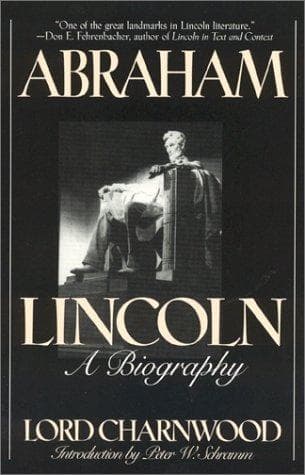
Abraham LincolnCharnwood, Godfrey Rathbone Benson, Baron
History
Abraham Lincoln
Charnwood, Godfrey Rathbone Benson, Baron
Lincoln, Abraham, 1809-1865; Presidents -- United States -- Biography
He was to prove that he could do this; it is for the following pages to
show in how high a degree. Meanwhile one thing should already be clear
about him. No shrewd judge of men could read his letters to Speed with
care and not feel that, whatever mistakes this man might commit,
fundamentally he was worthy of entire trust. That, as a matter of
fact, is what, to the end of his life, Speed and all the men who knew
him and an ever widening circle of men who had to judge by more casual
impressions did feel about Lincoln. Whatever was questionable in his
private or public acts, his own explanation, if he happened to give
one, would be taken by them as the full and naked truth, and, if there
was no known explanation, it remained to them an irrebuttable
presumption that his main intention was right.
CHAPTER IV
LINCOLN IN CONGRESS AND IN RETIREMENT
1. _The Mexican War and Lincoln's Work in Congress_.
Lincoln had ceased before his marriage to sit in the Illinois
Legislature. He had won sufficient standing for his ambition to aim
higher; a former law partner of his was now in Congress, and he wished
to follow. But he had to submit to a few years' delay of which the
story is curious and honourable. His rivals for the representation of
his own constituency were two fellow Whigs, Baker and Hardin, both of
whom afterwards bore distinguished parts in the Mexican war and with
both of whom he was friendly. Somewhat to his disgust at a party
gathering in his own county in 1843, Baker was preferred to him. A
letter of his gives a shrewd account of the manoeuvres among members of
various Churches which brought this about; it is curiously careful not
to overstate the effect of these influences and characteristically
denies that Baker had part in them. To make the thing harder, he was
sent from this meeting to a convention, for the whole constituency,
with which the nomination lay, and his duty, of course, was to work for
Baker. Here it became obvious that Hardin would be chosen; nothing
could be done for Baker at that time, but Lincoln, being against his
will there in Baker's interests, took an opportunity in the bargaining
that took place to advance Baker's claim, to the detriment of his own,
to be Hardin's successor two years later.
Public-domain text, read in full here on John Shaqi.
Reviews
Reviews
No reviews yet
Be the first to share your thoughts on this work.
Elsewhere in the archive
Join the Discussion
Join the discussion
Sign in to leave a comment or review.
Sign InorCreate an account