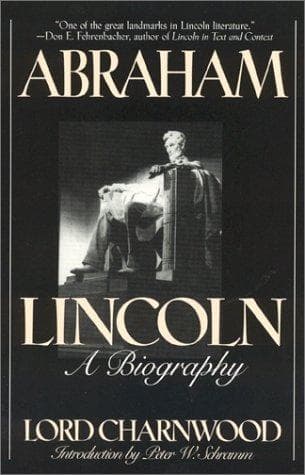
Abraham LincolnCharnwood, Godfrey Rathbone Benson, Baron
History
Abraham Lincoln
Charnwood, Godfrey Rathbone Benson, Baron
Lincoln, Abraham, 1809-1865; Presidents -- United States -- Biography
It has been said that the motive for the conquests from Mexico was the
desire for slave territory. The attractive part of the new dominion
was of course California. Arizona and New Mexico are arid regions, and
the mineral wealth of Nevada was unknown. The peacefully acquired
region of Oregon, far north, need not concern us, but Oregon became a
free State in 1859. Early in the war a struggle began between
Northerners and Southerners (to a large extent independent of party) in
the Senate and the House as to whether slavery should be allowed in the
conquered land or not. David Wilmot, a Northern Democratic
Congressman, proposed a proviso to the very first money grant connected
with the war, that slavery should be forbidden in any territory to be
annexed. The "Wilmot Proviso" was proposed again on every possible
occasion; Lincoln, by the way, sturdily supported it while in Congress;
it was always voted down. Cass proposed as a solution of all
difficulties that the question of slavery should be left to the people
of the new Territories or States themselves. The American public, apt
as condensing an argument into a phrase, dismissed Cass's principle for
the time being with the epithet "squatter sovereignty." Calhoun and
his friends said it was contrary to the Constitution that an American
citizen should not be free to move with his property, including his
slaves, into territory won by the Union. The annexation was carried
out, and the question of slavery was unsettled. Then events took a
surprising turn.
In the winter of 1848 gold was discovered in California. Throughout
1849 gold-seekers came pouring in from every part of the world. This
miscellaneous new people, whose rough ways have been more celebrated in
literature than those of any similar crowd, lived at first in
considerable anarchy, but they determined without delay to set up some
regular system of government. In the course of 1849 they elected a
Convention to draw up a State Constitution, and to the astonishment of
all the States the Convention unanimously made the prohibition of
slavery part of that Constitution. There was no likelihood that, with
a further influx of settlers of the same sort, this decision of
California would alter. Was California to be admitted as a State with
this Constitution of its own choice, which the bulk of the people of
America approved?
Public-domain text, read in full here on John Shaqi.
Reviews
Reviews
No reviews yet
Be the first to share your thoughts on this work.
Elsewhere in the archive
Join the Discussion
Join the discussion
Sign in to leave a comment or review.
Sign InorCreate an account