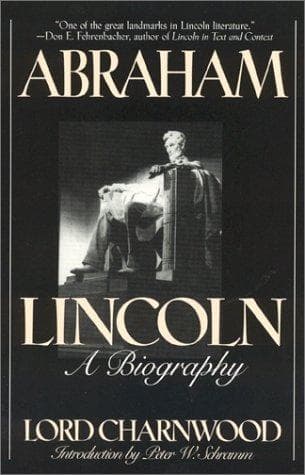
Abraham LincolnCharnwood, Godfrey Rathbone Benson, Baron
History
Abraham Lincoln
Charnwood, Godfrey Rathbone Benson, Baron
Lincoln, Abraham, 1809-1865; Presidents -- United States -- Biography
To politicians of the school now fully developed in the South there
seemed nothing outrageous in saying that it should be refused
admission. To them Calhoun's argument, which regarded a citizen's
slave as his chattel in the same sense as his hat or walking-stick,
seemed the ripe fruit of logic. It did not shock them in the least
that they were forcing the slave system on an unwilling community, for
were not the Northerners prepared to force the free system? A
prominent Southern Senator, talking with a Northern colleague a little
later, said triumphantly: "I see how it is. You may force freedom as
much as you like, but we are to beware how we force slavery," and was
surprised that the Northerner cheerfully accepted this position. It is
necessary to remember throughout the following years that, whatever
ordinary Southerners thought in private, their whole political action
was now based on the assumption that slavery, as it was, was an
institution which no reasonable man could think wrong.
Zachary Taylor, unlike Harrison, the previous hero of the Whigs,
survived his inauguration by sixteen months. He was no politician at
all, but placed in the position of President, for which fairness and
firmness were really the greatest qualifications, he was man enough to
rely on his own good sense. He had come to Washington under the
impression that the disputes which raged there were due to the
aggressiveness of the North; a very little time there convinced him of
the contrary. Slave-owner as he was, the claim of the South to force
slavery on California struck him as an arrogant pretension, and so far
as matters rested with him, he was simply not to be moved by it. He
sent a message to Congress advising the admission of California with
the constitution of its own choice. When, as we shall shortly see, the
great men of the Senate thought the case demanded conciliation and a
great scheme of compromise, he resolutely disagreed; he used the whole
of his influence against their compromise, and it is believed with good
reason that he would have put his veto as President on the chief
measure in which the compromise issued. If he had lived to carry out
his policy, it seems possible that there would have been an attempt to
execute the threats of secession which were muttered--this time in
Virginia. But it is almost certain that at that time, and with the
position which he occupied, he would have been able to quell the
movement at once. There is nothing to suggest that Taylor was a man of
any unusual gifts of intellect, but he had what we may call character,
and it was the one thing wanting in political life at the time. The
greatest minds in American politics, as we shall see, viewed the
occasion otherwise, but, in the light of what followed, it seems a
signal and irreparable error that, when the spirit of aggression rising
in the South had taken definite shape in a demand which was manifestly
Public-domain text, read in full here on John Shaqi.
Reviews
Reviews
No reviews yet
Be the first to share your thoughts on this work.
Elsewhere in the archive
Join the Discussion
Join the discussion
Sign in to leave a comment or review.
Sign InorCreate an account