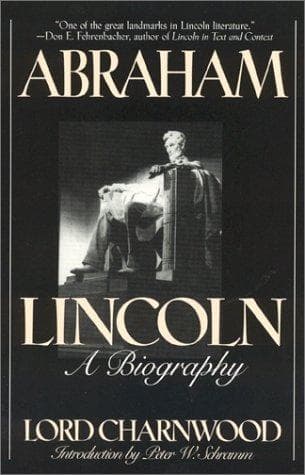
Abraham LincolnCharnwood, Godfrey Rathbone Benson, Baron
History
Abraham Lincoln
Charnwood, Godfrey Rathbone Benson, Baron
Lincoln, Abraham, 1809-1865; Presidents -- United States -- Biography
strain: "Gentlemen of the Jury, are you prepared that these two young
men shall enter upon life and go through life with the stain of a
dishonourable transaction for ever affixed to them," and so forth at
just sufficient length and with just enough of Shakespearean padding
about honour. The result with that emotional and probably irregular
Western court is obvious, and the story concludes with the quite
credible assertion that the defendants themselves were relieved. Any
good jury would, of course, have been steeled against the appeal, which
might have been expected, to their compassion for a poor and honest old
man. A kind of innocent and benign cunning has been the most engaging
quality in not a few great characters. It is tempting, though at the
risk of undue solemnity, to look for the secret of Lincoln's cunning in
this instance. We know from copybooks and other sources that these two
young men, starting on the down grade with the help of their
blackguardly legal adviser, were objects for pity, more so than the man
who was about to lose a certain number of dollars. Lincoln, as few
other men would have done, felt a certain actual regret for them then
and there; he felt it so naturally that he knew the same sympathy could
be aroused, at least in twelve honest men who already wished they could
find for the plaintiff. It has often been remarked that the cause of
his later power was a knowledge of the people's mind which was
curiously but vitally bound up with his own rectitude.
Any attempt that we may make to analyse a subtle character and in some
respects to trace its growth is certain to miss the exact mark. But it
is in any case plain that Abraham Lincoln left political life in 1849,
a praiseworthy self-made man with good sound views but with nothing
much to distinguish him above many other such, and at a sudden call
returned to political life in 1854 with a touch of something quite
uncommon added to those good sound views.
4. _The Repeal of the Missouri Compromise_.
The South had become captive to politicians, personally reputable and
of some executive capacity, who had converted its natural prejudice
into a definite doctrine which was paradoxical and almost inconceivably
narrow, and who, as is common in such instances of perversion and
fanaticism, knew hardly any scruple in the practical enforcement of
their doctrine. In the North, on the other hand, though there were
some few politicians who were clever and well-intentioned, public
opinion had no very definite character, and public men generally
speaking were flabby. At such a time the sheer adventurer has an
excellent field before him and perhaps has his appointed use.
Public-domain text, read in full here on John Shaqi.
Reviews
Reviews
No reviews yet
Be the first to share your thoughts on this work.
Elsewhere in the archive
Join the Discussion
Join the discussion
Sign in to leave a comment or review.
Sign InorCreate an account