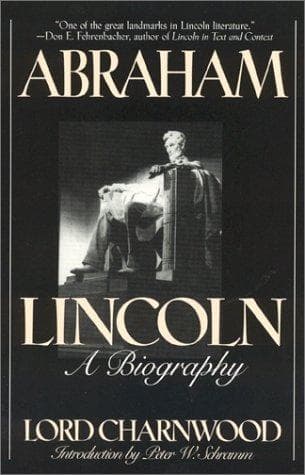
Abraham LincolnCharnwood, Godfrey Rathbone Benson, Baron
History
Abraham Lincoln
Charnwood, Godfrey Rathbone Benson, Baron
Lincoln, Abraham, 1809-1865; Presidents -- United States -- Biography
Stephen Douglas, who was four years younger than Lincoln, had come to
Illinois from the Eastern States just about the time when Lincoln
entered the Legislature. He had neither money nor friends to start
with, but almost immediately secured, by his extraordinary address in
pushing himself, a clerkship in the Assembly. He soon became, like
Lincoln, a lawyer and a legislator, but was on the Democratic side. He
rapidly soared into regions beyond the reach of Lincoln, and in 1847
became a Senator for Illinois, where he later became Chairman of the
Committee on Territories, and as such had to consider the question of
providing for the government of the districts called Kansas and
Nebraska, which lay west and north-west of Missouri, and from which
slavery was excluded by the Missouri Compromise. He was what in
England is called a "Jingo," and was at one time eager to fight this
country for the possession of what is now British Columbia. His short
figure gave an impression of abounding strength and energy which
obtained him the nickname of "the little Giant." With no assignable
higher quality, and with the blustering, declamatory, shamelessly
fallacious and evasive oratory of a common demagogue, he was
nevertheless an accomplished Parliamentarian, and imposed himself as
effectively upon the Senate as he did upon the people of Illinois and
the North generally. He was, no doubt, a remarkable man, with the gift
of attracting many people. A political opponent has described vividly
how at first sight he was instantly repelled by the sinister and
dangerous air of Douglas' scowl; a still stronger opponent, but a
woman, Mrs. Beecher Stowe, seems on the contrary to have found it
impossible to hate him. What he now did displayed at any rate a
sporting quality.
In the course of 1854 Stephen Douglas while in charge of an inoffensive
Bill dealing with the government of Kansas and Nebraska converted it
into a form in which it empowered the people of Kansas at any time to
decide for themselves whether they would permit slavery or not, and in
express terms repealed the Missouri Compromise. With the easy
connivance of President Pierce and the enthusiastic support of the
Southerners, and by some extraordinary exercise of his art as demagogue
and Parliamentarian, he triumphantly ran this measure through.
Public-domain text, read in full here on John Shaqi.
Reviews
Reviews
No reviews yet
Be the first to share your thoughts on this work.
Elsewhere in the archive
Join the Discussion
Join the discussion
Sign in to leave a comment or review.
Sign InorCreate an account