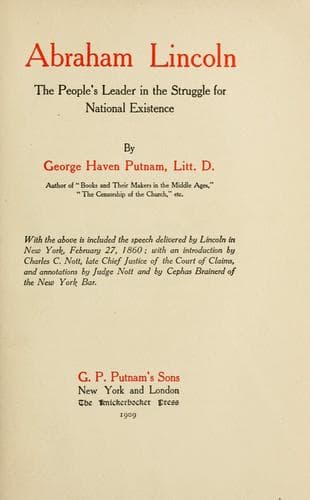
Abraham Lincoln: The People's Leader in the Struggle for National ExistencePutnam, George Haven
History
Abraham Lincoln: The People's Leader in the Struggle for National Existence
Putnam, George Haven
Lincoln, Abraham, 1809-1865; United States -- History -- Civil War, 1861-1865
In making up the notes, we ransacked, as you may be sure, all the
material available in the libraries in New York, and I also had
interviews as to one special point with Mr. Bancroft, with Mr.
Hildreth, and with Dr. William Goodell, who was in those times a
famous anti-slavery man.
Your father[3] and William Curtis Noyes were possibly more
completely in sympathy than any other two men in New York, with the
efforts of these younger men; they impressed me as standing in that
respect on the same plane. The next man to them was Charles Wyllis
Elliott, the author of a _History of New England_. We never went to
your father for advice or assistance when he failed to help us, and
he was always so kindly and gentle in what he did and said that
every one of us youngsters acquired for him a very great affection.
He always had time to see us and was always on hand when he was
wanted, and if we desired to have anything, we got it if he had it.
Neither your father, nor Mr. Noyes, nor for that matter Mr. Elliott,
ever suggested that we were "young" or "fresh" or anything of that
sort. The enthusiasm which young fellows have was always recognised
by these men as an exceedingly valuable asset in the cause....
Pardon all this from a "veteran," and believe me,
Sincerely yours,
CEPHAS BRAINERD.
INTRODUCTION
BY CHARLES C. NOTT
The Cooper Institute address is one of the most important addresses ever
delivered in the life of this nation, for at an eventful time it changed
the course of history. When Mr. Lincoln rose to speak on the evening of
February 27, 1860, he had held no administrative office; he had
endeavoured to be appointed Commissioner of Patents, and had failed; he
had sought to be elected United States Senator, and had been defeated;
he had been a member of Congress, yet it was not even remembered; he was
a lawyer in humble circumstances, persuasive of juries, but had not
reached the front rank of the Illinois Bar. The record which Mr. Lincoln
himself placed in the Congressional Directory in 1847 might still be
taken as the record of his public and official life: "Born February
12th, 1809, in Hardin County, Kentucky. Education defective. Profession
a lawyer. Have been a captain of volunteers in the Black Hawk War.
Postmaster in a very small office. Four times a member of the Illinois
Legislature and a member of the lower house of Congress." Was this the
record of a man who should be made the head of a nation in troubled
times? In the estimation of thoughtful Americans east of the Alleghanies
all that they knew of Mr. Lincoln justified them in regarding him as
only "a Western stump orator"--successful, distinguished, but nothing
higher than that--a Western stump orator, who had dared to brave one of
the strongest men in the Western States, and who had done so with
wonderful ability and moral success. When Mr. Lincoln closed his address
Public-domain text, read in full here on John Shaqi.
Reviews
Reviews
No reviews yet
Be the first to share your thoughts on this work.
Elsewhere in the archive
Join the Discussion
Join the discussion
Sign in to leave a comment or review.
Sign InorCreate an account