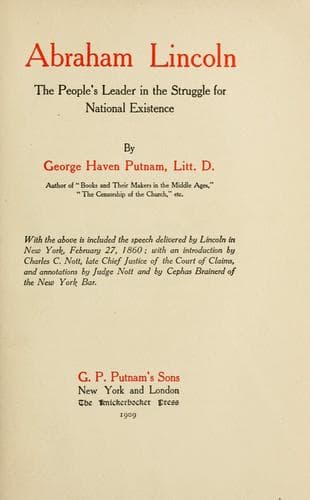
Abraham Lincoln: The People's Leader in the Struggle for National ExistencePutnam, George Haven
History
Abraham Lincoln: The People's Leader in the Struggle for National Existence
Putnam, George Haven
Lincoln, Abraham, 1809-1865; United States -- History -- Civil War, 1861-1865
he had risen to the rank of statesman, and had stamped himself a
statesman peculiarly fitted for the exigency of the hour.
Mr. William Cullen Bryant presided at the meeting; and a number of the
first and ablest citizens of New York were present, among them Horace
Greeley. Mr. Greeley was pronounced in his appreciation of the address;
it was the ablest, the greatest, the wisest speech that had yet been
made; it would reassure the conservative Northerner; it was just what
was wanted to conciliate the excited Southerner; it was conclusive in
its argument, and would assure the overthrow of Douglas. Mr. Horace
White has recently written: "I chanced to open the other day his Cooper
Institute speech. This is one of the few printed speeches that I did not
hear him deliver in person. As I read the concluding pages of that
speech, the conflict of opinion that preceded the conflict of arms then
sweeping upon the country like an approaching solar eclipse seemed
prefigured like a chapter of the Book of Fate. Here again he was the
Old Testament prophet, before whom Horace Greeley bowed his head, saying
that he had never listened to a greater speech, although he had heard
several of Webster's best." Later, Mr. Greeley became the leader of the
Republican forces opposed to the nomination of Mr. Seward and was
instrumental in concentrating those forces upon Mr. Lincoln.
Furthermore, the great New York press on the following morning carried
the address to the country, and before Mr. Lincoln left New York he was
telegraphed from Connecticut to come and aid in the campaign of the
approaching spring election. He went, and when the fateful moment came
in the Convention, Connecticut was one of the Eastern States which first
broke away from the Seward column and went over to Mr. Lincoln. When
Connecticut did this, the die was cast.
It is difficult for younger generations of Americans to believe that
three months before Mr. Lincoln was nominated for the Presidency he was
neither appreciated nor known in New York. That fact can be better
established by a single incident than by the opinions and assurances of
a dozen men.
Public-domain text, read in full here on John Shaqi.
Reviews
Reviews
No reviews yet
Be the first to share your thoughts on this work.
Elsewhere in the archive
Join the Discussion
Join the discussion
Sign in to leave a comment or review.
Sign InorCreate an account