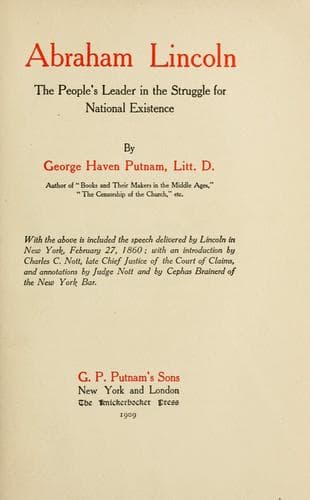
Abraham Lincoln: The People's Leader in the Struggle for National ExistencePutnam, George Haven
History
Abraham Lincoln: The People's Leader in the Struggle for National Existence
Putnam, George Haven
Lincoln, Abraham, 1809-1865; United States -- History -- Civil War, 1861-1865
His companion in the street car has often wondered since then what Mr.
Lincoln thought about during the remainder of his ride that night to the
Astor House. The Cooper Institute had, owing to a snowstorm, not been
full, and its intelligent, respectable, non-partisan audience had not
rung out enthusiastic applause like a concourse of Western auditors
magnetised by their own enthusiasm. Had the address--the most carefully
prepared, the most elaborately investigated and demonstrated and
verified of all the work of his life--been a failure? But in the matter
of quality and ability, if not of quantity and enthusiasm, he had never
addressed such an audience; and some of the ablest men in the Northern
States had expressed their opinion of the address in terms which left no
doubt of the highest appreciation. Did Mr. Lincoln regard the address
which he had just delivered to a small and critical audience as a
success? Did he have the faintest glimmer of the brilliant effect which
was to follow? Did he feel the loneliness of the situation--the want of
his loyal Illinois adherents? Did his sinking heart infer that he was
but a speck of humanity to which the great city would never again give a
thought? He was a plain man, an ungainly man; unadorned, apparently
uncultivated, showing the awkwardness of self-conscious rusticity. His
dress that night before a New York audience was the most unbecoming that
a fiend's ingenuity could have devised for a tall, gaunt man--a black
frock coat, ill-setting and too short for him in the body, skirt, and
arms--a rolling collar, low-down, disclosing his long thin, shrivelled
throat uncovered and exposed. No man in all New York appeared that night
more simple, more unassuming, more modest, more unpretentious, more
conscious of his own defects than Abraham Lincoln; and yet we now know
that within his soul there burned the fires of an unbounded ambition,
sustained by a self-reliance and self-esteem that bade him fix his gaze
upon the very pinnacle of American fame and aspire to it in a time so
troubled that its dangers appalled the soul of every American. What were
this man's thoughts when he was left alone? Did a faint shadow of the
future rest upon his soul? Did he feel in some mysterious way that on
that night he had crossed the Rubicon of his life-march--that care and
trouble and political discord, and slander and misrepresentation and
ridicule and public responsibilities, such as hardly ever before
burdened a conscientious soul, coupled with war and defeat and disaster,
were to be thenceforth his portion nearly to his life's end, and that
his end was to be a bloody act which would appall the world and send a
thrill of horror through the hearts of friends and enemies alike, so
that when the woeful tidings came the bravest of the Southern brave
should burst into tears and cry aloud, "Oh! the unhappy South, the
unhappy South!"
Public-domain text, read in full here on John Shaqi.
Reviews
Reviews
No reviews yet
Be the first to share your thoughts on this work.
Elsewhere in the archive
Join the Discussion
Join the discussion
Sign in to leave a comment or review.
Sign InorCreate an account