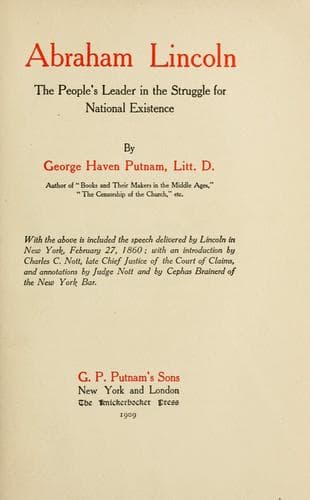
Abraham Lincoln: The People's Leader in the Struggle for National ExistencePutnam, George Haven
History
Abraham Lincoln: The People's Leader in the Struggle for National Existence
Putnam, George Haven
Lincoln, Abraham, 1809-1865; United States -- History -- Civil War, 1861-1865
After the address had been delivered, Mr. Lincoln was taken by two
members of the Young Men's Central Republican Union--Mr. Hiram Barney,
afterward Collector of the Port of New York, and Mr. Nott, one of the
subsequent editors of the address--to their club, The Athenæum, where
a very simple supper was ordered, and five or six Republican members of
the club who chanced to be in the building were invited in. The supper
was informal--as informal as anything could be; the conversation was
easy and familiar; the prospects of the Republican party in the coming
struggle were talked over, and so little was it supposed by the
gentlemen who had not heard the address that Mr. Lincoln could possibly
be the candidate that one of them, Mr. Charles W. Elliott, asked,
artlessly: "Mr. Lincoln, what candidate do you really think would be
most likely to carry Illinois?" Mr. Lincoln answered by illustration:
"Illinois is a peculiar State, in three parts. In northern Illinois, Mr.
Seward would have a larger majority than I could get. In middle
Illinois, I think I could call out a larger vote than Mr. Seward. In
southern Illinois, it would make no difference who was the candidate."
This answer was taken to be merely illustrative by everybody except,
perhaps, Mr. Barney and Mr. Nott, each of whom, it subsequently
appeared, had particularly noted Mr. Lincoln's reply.
The little party broke up. Mr. Lincoln had been cordially received, but
certainly had not been flattered. The others shook him by the hand and,
as they put on their overcoats, said: "Mr. Nott is going down town and
he will show you the way to the Astor House." Mr. Lincoln and Mr. Nott
started on foot, but the latter observing that Mr. Lincoln was
apparently Walking with some difficulty said, "Are you lame, Mr.
Lincoln?" He replied that he had on new boots and they hurt him. The two
gentlemen then boarded a street car. When they reached the place where
Mr. Nott would leave the car on his way home, he shook Mr. Lincoln by
the hand and, bidding him good-bye, told him that this car would carry
him to the side door of the Astor House. Mr. Lincoln went on alone, the
only occupant of the car. The next time he came to New York, he rode
down Broadway to the Astor House standing erect in an open barouche
drawn by four white horses. He bowed to the patriotic thousands in the
street, on the sidewalks, in the windows, on the house-tops, and they
cheered him as the lawfully elected President of the United States and
bade him go on and, with God's help, save the Union.
Public-domain text, read in full here on John Shaqi.
Reviews
Reviews
No reviews yet
Be the first to share your thoughts on this work.
Elsewhere in the archive
Join the Discussion
Join the discussion
Sign in to leave a comment or review.
Sign InorCreate an account