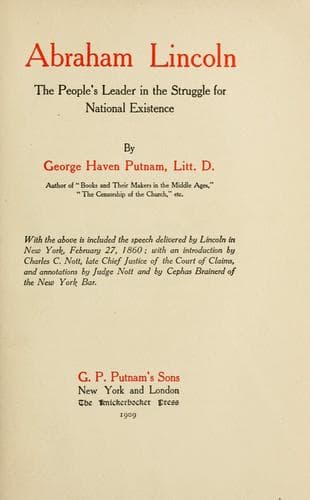
Abraham Lincoln: The People's Leader in the Struggle for National ExistencePutnam, George Haven
History
Abraham Lincoln: The People's Leader in the Struggle for National Existence
Putnam, George Haven
Lincoln, Abraham, 1809-1865; United States -- History -- Civil War, 1861-1865
I fully indorse this, and I adopt it as a text for this discourse. I
so adopt it because it furnishes a precise and an agreed
starting-point for a discussion between Republicans and that wing of
the Democracy headed by Senator Douglas. It simply leaves the
inquiry: "_What was the understanding those fathers had of the
question mentioned_?"
What is the frame of Government under which we live?
The answer must be: "The Constitution of the United States." That
Constitution consists of the original, framed in 1787, (and under
which the present Government first went into operation,) and twelve
subsequently framed amendments, the first ten of which were framed
in 1789.[4]
Who were our fathers that framed the Constitution? I suppose the
"thirty-nine" who signed the original instrument may be fairly
called our fathers who framed that part of the present Government.
It is almost exactly true to say they framed it, and it is
altogether true to say they fairly represented the opinion and
sentiment of the whole nation at that time. Their names, being
familiar to nearly all, and accessible to quite all, need not now be
repeated.[5]
I take these "thirty-nine" for the present, as being "our fathers
who framed the Government under which we live."
What is the question which, according to the text, those fathers
understood "just as well, and even better than we do now"?
It is this: Does the proper division of local from federal
authority, or anything in the Constitution, forbid _our Federal
Government_ to control as to slavery in _our Federal Territories_?
Upon this, Senator Douglas holds the affirmative, and Republicans
the negative. This affirmation and denial form an issue; and this
issue--this question--is precisely what the text declares our
fathers understood "better than we."
Let us now inquire whether the "thirty-nine," or any of them, ever
acted upon this question; and if they did, how they acted upon
it--how they expressed that better understanding.
In 1784, three years before the Constitution--the United States then
owning the Northwestern Territory, and no other,[6] the Congress of
the Confederation had before them the question of prohibiting
slavery in that Territory; and four of the "thirty-nine" who
afterward framed the Constitution, were in that Congress, and voted
on that question. Of these, Roger Sherman, Thomas Mifflin, and Hugh
Williamson voted for the prohibition,[7] thus showing that, in their
understanding, no line dividing local from federal authority, nor
anything else, properly forbade the Federal Government to control as
to slavery in federal territory. The other of the four--James
M'Henry--voted against the prohibition, showing that, for some
cause, he thought it improper to vote for it.[8]
Public-domain text, read in full here on John Shaqi.
Reviews
Reviews
No reviews yet
Be the first to share your thoughts on this work.
Elsewhere in the archive
Join the Discussion
Join the discussion
Sign in to leave a comment or review.
Sign InorCreate an account