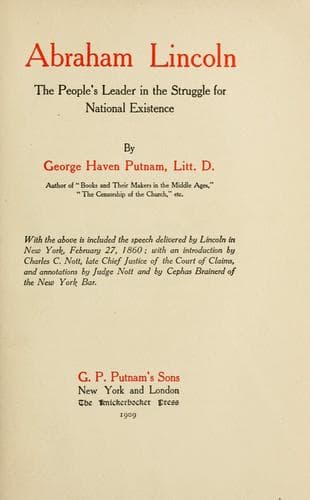
Abraham Lincoln: The People's Leader in the Struggle for National ExistencePutnam, George Haven
History
Abraham Lincoln: The People's Leader in the Struggle for National Existence
Putnam, George Haven
Lincoln, Abraham, 1809-1865; United States -- History -- Civil War, 1861-1865
In 1787, still before the Constitution, but while the Convention was
in session framing it, and while the Northwestern Territory still
was the only territory owned by the United States, the same question
of prohibiting Slavery in the Territories again came before the
Congress of the Confederation; and two more of the "thirty-nine" who
afterward signed the Constitution, were in that Congress, and voted
on the question. They were William Blount and William Few[9]; and
they both voted for the prohibition--thus showing that, in their
understanding, no line dividing local from federal authority, nor
anything else, properly forbade the Federal Government to control as
to slavery in federal territory. This time, the prohibition became a
law, being part of what is now well known as the Ordinance of
'87.[10]
The question of federal control of slavery in the territories, seems
not to have been directly before the Convention which framed the
original Constitution; and hence it is not recorded that the
"thirty-nine," or any of them, while engaged on that instrument,
expressed any opinion on that precise question.[11]
In 1789, by the first Congress which sat under the Constitution, an
act was passed to enforce the Ordinance of '87, including the
prohibition of slavery in the Northwestern Territory. The bill for
this act was reported by one of the "thirty-nine," Thomas
Fitzsimmons, then a member of the House of Representatives from
Pennsylvania. It went through all its stages without a word of
opposition, and finally passed both branches without yeas and nays,
which is equivalent to an unanimous passage.[12] In this Congress,
there were sixteen of the thirty-nine fathers who framed the
original Constitution. They were John Langdon, Nicholas Oilman, Wm.
S. Johnson, Roger Sherman, Robert Morris, Thos. Fitzsimmons, William
Few, Abraham Baldwin, Rufus King, William Paterson, George Clymer,
Richard Bassett, George Read, Pierce Butler, Daniel Carroll, James
Madison.[13]
This shows that, in their understanding, no line dividing local from
federal authority, nor anything in the Constitution, properly
forbade Congress to prohibit slavery in the federal territory; else
both their fidelity to correct principle, and their oath to support
the Constitution, would have constrained them to oppose the
prohibition.
Again, George Washington, another of the "thirty-nine," was then
President of the United States, and, as such, approved and signed
the bill; thus completing its validity as a law, and thus showing
that, in his understanding, no line dividing local from federal
authority, nor anything in the Constitution, forbade the Federal
Government to control as to slavery in federal territory.
Public-domain text, read in full here on John Shaqi.
Reviews
Reviews
No reviews yet
Be the first to share your thoughts on this work.
Elsewhere in the archive
Join the Discussion
Join the discussion
Sign in to leave a comment or review.
Sign InorCreate an account