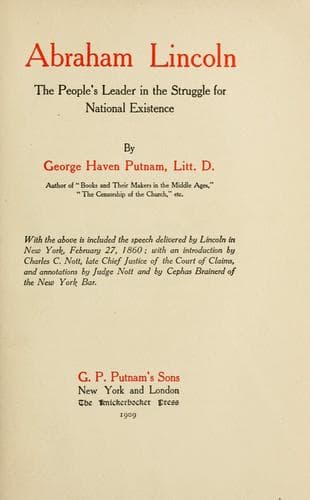
Abraham Lincoln: The People's Leader in the Struggle for National ExistencePutnam, George Haven
History
Abraham Lincoln: The People's Leader in the Struggle for National Existence
Putnam, George Haven
Lincoln, Abraham, 1809-1865; United States -- History -- Civil War, 1861-1865
This act also was passed without yeas and nays. In the Congress
which passed it, there were two of the "thirty-nine." They were
Abraham Baldwin and Jonathan Dayton.[18] As stated in the case of
Mississippi, it is probable they both voted for it. They would not
have allowed it to pass without recording their opposition to it,
if, in their understanding, it violated either the line properly
dividing local from federal authority, or any provision of the
Constitution.
In 1819-20, came and passed the Missouri question. Many votes were
taken, by yeas and nays, in both branches of Congress, upon the
various phases of the general question. Two of the
"thirty-nine"--Rufus King and Charles Pinckney--were members of
that Congress.[19] Mr. King steadily voted for slavery prohibition
and against all compromises, while Mr. Pinckney as steadily voted
against slavery prohibition and against all compromises. By this,
Mr. King showed that, in his understanding, no line dividing local
from federal authority, nor anything in the Constitution, was
violated by Congress prohibiting slavery in federal territory; while
Mr. Pinckney, by his votes, showed that, in his understanding, there
was some sufficient reason for opposing such prohibition in that
case.[20]
The cases I have mentioned are the only acts of the "thirty-nine,"
or of any of them, upon the direct issue, which I have been able to
discover.
To enumerate the persons who thus acted, as being four in 1784, two
in 1787, seventeen in 1789, three in 1798, two in 1804, and two in
1819-20--there would be thirty of them. But this would be counting
John Langdon, Roger Sherman, William Few, Rufus King, and George
Read each twice, and Abraham Baldwin three times. The true number of
those of the "thirty-nine" whom I have shown to have acted upon the
question, which, by the text, they understood better than we, is
twenty-three, leaving sixteen not shown to have acted upon it in
anyway.[21]
Here, then, we have twenty-three out of our thirty-nine fathers "who
framed the Government under which we live," who have, upon their
official responsibility and their corporal oaths, acted upon the
very question which the text affirms they "understood just as well,
and even better than we do now"; and twenty-one of them--a clear
majority of the whole "thirty-nine"--so acting upon it as to make
them guilty of gross political impropriety and wilful perjury, if,
in their understanding, any proper division between local and
federal authority, or anything in the Constitution they had made
themselves, and sworn to support, forbade the Federal Government to
control as to slavery in the federal territories. Thus the
twenty-one acted; and, as actions speak louder than words, so
actions under such responsibility speak still louder.
Public-domain text, read in full here on John Shaqi.
Reviews
Reviews
No reviews yet
Be the first to share your thoughts on this work.
Elsewhere in the archive
Join the Discussion
Join the discussion
Sign in to leave a comment or review.
Sign InorCreate an account