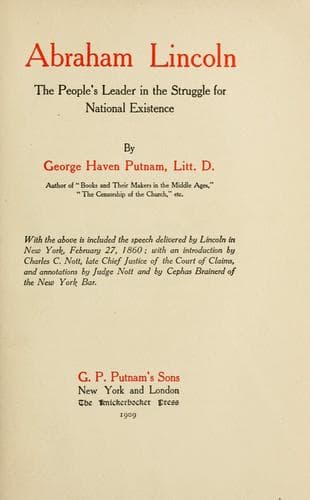
Abraham Lincoln: The People's Leader in the Struggle for National ExistencePutnam, George Haven
History
Abraham Lincoln: The People's Leader in the Struggle for National Existence
Putnam, George Haven
Lincoln, Abraham, 1809-1865; United States -- History -- Civil War, 1861-1865
Two of the twenty-three voted against Congressional prohibition of
slavery in the federal territories, in the instances in which they
acted upon the question. But for what reasons they so voted is not
known. They may have done so because they thought a proper division
of local from federal authority, or some provision or principle of
the Constitution, stood in the way; or they may, without any such
question, have voted against the prohibition on what appeared to
them to be sufficient grounds of expediency. No one who has sworn to
support the Constitution can conscientiously vote for what he
understands to be an unconstitutional measure, however expedient he
may think it; but one may and ought to vote against a measure which
he deems constitutional, if, at the same time, he deems it
inexpedient. It, therefore, would be unsafe to set down even the two
who voted against the prohibition, as having done so because, in
their understanding, any proper division of local from federal
authority, or anything in the Constitution, forbade the Federal
Government to control as to slavery in federal territory.[22]
The remaining sixteen of the "thirty-nine," so far as I have
discovered, have left no record of their understanding upon the
direct question of federal control of slavery in the federal
territories. But there is much reason to believe that their
understanding upon that question would not have appeared different
from that of their twenty-three compeers, had it been manifested at
all.[23]
For the purpose of adhering rigidly to the text, I have purposely
omitted whatever understanding may have been manifested by any
person, however distinguished, other than the thirty-nine fathers
who framed the original Constitution; and, for the same reason, I
have also omitted whatever understanding may have been manifested by
any of the "thirty-nine" even, on any other phase of the general
question of slavery. If we should look into their acts and
declarations on those other phases, as the foreign slave trade, and
the morality and policy of slavery generally, it would appear to us
that on the direct question of federal control of slavery in federal
territories, the sixteen, if they had acted at all, would probably
have acted just as the twenty-three did. Among that sixteen were
several of the most noted anti-slavery men of those times--as Dr.
Franklin, Alexander Hamilton, and Gouverneur Morris--while there was
not one now known to have been otherwise, unless it may be John
Rutledge, of South Carolina.[24]
Public-domain text, read in full here on John Shaqi.
Reviews
Reviews
No reviews yet
Be the first to share your thoughts on this work.
Elsewhere in the archive
Join the Discussion
Join the discussion
Sign in to leave a comment or review.
Sign InorCreate an account