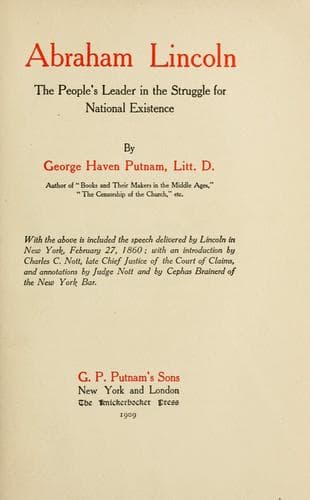
Abraham Lincoln: The People's Leader in the Struggle for National ExistencePutnam, George Haven
History
Abraham Lincoln: The People's Leader in the Struggle for National Existence
Putnam, George Haven
Lincoln, Abraham, 1809-1865; United States -- History -- Civil War, 1861-1865
Is it not a little presumptuous in any one at this day to affirm
that the two things which that Congress deliberately framed, and
carried to maturity at the same time, are absolutely inconsistent
with each other? And does not such affirmation become impudently
absurd when coupled with the other affirmation from the same mouth,
that those who did the two things, alleged to be inconsistent,
understood whether they really were inconsistent better than
we--better than he who affirms that they are inconsistent?
It is surely safe to assume that the thirty-nine framers of the
original Constitution, and the seventy-six members of the Congress
which framed the amendments thereto, taken together, do certainly
include those who may be fairly called "our fathers who framed the
Government under which we live."[27] And so assuming, I defy any man
to show that any one of them ever, in his whole life, declared that,
in his understanding, any proper division of local from federal
authority, or any part of the Constitution, forbade the Federal
Government to control as to slavery in the federal territories. I go
a step further. I defy any one to show that any living man in the
whole world ever did, prior to the beginning of the present
century, (and I might almost say prior to the beginning of the last
half of the present century,) declare that, in his understanding,
any proper division of local from federal authority, or any part of
the Constitution, forbade the Federal Government to control as to
slavery in the federal territories. To those who now so declare, I
give, not only "our fathers who framed the Government under which we
live," but with them all other living men within the century in
which it was framed, among whom to search, and they shall not be
able to find the evidence of a single man agreeing with them.
Now, and here, let me guard a little against being misunderstood. I
do not mean to say we are bound to follow implicitly in whatever our
fathers did. To do so, would be to discard all the lights of current
experience--to reject all progress--all improvement. What I do say
is, that if we would supplant the opinions and policy of our fathers
in any case, we should do so upon evidence so conclusive, and
argument so clear, that even their great authority, fairly
considered and weighed, cannot stand; and most surely not in a case
whereof we ourselves declare they understood the question better
than we.
Public-domain text, read in full here on John Shaqi.
Reviews
Reviews
No reviews yet
Be the first to share your thoughts on this work.
Elsewhere in the archive
Join the Discussion
Join the discussion
Sign in to leave a comment or review.
Sign InorCreate an account