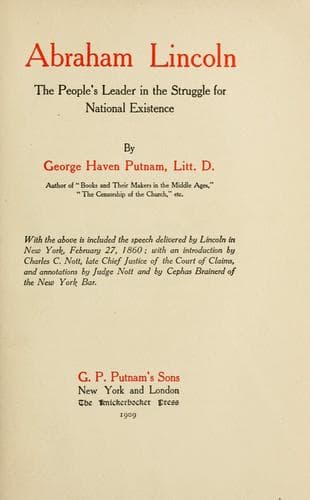
Abraham Lincoln: The People's Leader in the Struggle for National ExistencePutnam, George Haven
History
Abraham Lincoln: The People's Leader in the Struggle for National Existence
Putnam, George Haven
Lincoln, Abraham, 1809-1865; United States -- History -- Civil War, 1861-1865
The sum of the whole is, that of our thirty-nine fathers who framed
the original Constitution, twenty-one--a clear majority of the
whole--certainly understood that no proper division of local from
federal authority, nor any part of the Constitution, forbade the
Federal Government to control slavery in the federal territories;
while all the rest probably had the same understanding. Such,
unquestionably, was the understanding of our fathers who framed the
original Constitution; and the text affirms that they understood the
question "better than we."
But, so far, I have been considering the understanding of the
question manifested by the framers of the original Constitution. In
and by the original instrument, a mode was provided for amending it;
and, as I have already stated, the present frame of "the Government
under which we live" consists of that original, and twelve
amendatory articles framed and adopted since. Those who now insist
that federal control of slavery in federal territories violates the
Constitution, point us to the provisions which they suppose it thus
violates; and, as I understand, they all fix upon provisions in
these amendatory articles and not in the original instrument. The
Supreme Court, in the Dred Scott case, plant themselves upon the
fifth amendment, which provides that no person shall be deprived of
"life, liberty or property without due process of law"; while
Senator Douglas and his peculiar adherents plant themselves upon the
tenth amendment, providing that "the powers not delegated to the
United States by the Constitution" "are reserved to the States
respectively, or to the people."[25]
Now, it so happens that these amendments were framed by the first
Congress which sat under the Constitution--the identical Congress
which passed the act already mentioned, enforcing the prohibition of
slavery in the Northwestern Territory. Not only was it the same
Congress, but they were the identical same individual men who, at
the same session, and at the same time within the session had under
consideration, and in progress toward maturity, these Constitutional
amendments, and this act prohibiting slavery in all the territory
the nation then owned. The Constitutional amendments were introduced
before, and passed after, the act enforcing the Ordinance of '87; so
that, during the whole pendency of the act to enforce the Ordinance,
the Constitutional amendments were also pending.[26]
The seventy-six members of that Congress, including sixteen of the
framers of the original Constitution, as before stated, were
pre-eminently our fathers who framed that part of "the Government
under which we live," which is now claimed as forbidding the Federal
Government to control slavery in the federal territories.
Public-domain text, read in full here on John Shaqi.
Reviews
Reviews
No reviews yet
Be the first to share your thoughts on this work.
Elsewhere in the archive
Join the Discussion
Join the discussion
Sign in to leave a comment or review.
Sign InorCreate an account