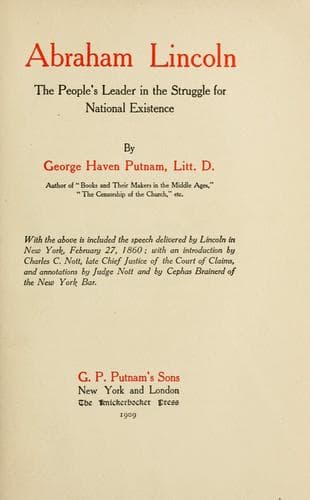
Abraham Lincoln: The People's Leader in the Struggle for National ExistencePutnam, George Haven
History
Abraham Lincoln: The People's Leader in the Struggle for National Existence
Putnam, George Haven
Lincoln, Abraham, 1809-1865; United States -- History -- Civil War, 1861-1865
When you make these declarations, you have a specific and
well-understood allusion to an assumed Constitutional right of
yours, to take slaves into the federal territories, and to hold them
there as property. But no such right is specifically written in the
Constitution. That instrument is literally silent about any such
right. We, on the contrary, deny that such a right has any existence
in the Constitution, even by implication.
Your purpose, then, plainly stated, is, that you will destroy the
Government, unless you be allowed to construe and enforce the
Constitution as you please, on all points in dispute between you and
us. You will rule or ruin in all events.
This, plainly stated, is your language. Perhaps you will say the
Supreme Court has decided the disputed Constitutional question in
your favor. Not quite so. But waiving the lawyer's distinction
between dictum and decision, the Court have decided the question for
you in a sort of way. The Court have substantially said, it is your
Constitutional right to take slaves into the federal territories,
and to hold them there as property. When I say the decision was made
in a sort of way, I mean it was made in a divided Court, by a bare
majority of the Judges, and they not quite agreeing with one another
in the reasons for making it;[34] that it is so made as that its
avowed supporters disagree with one another about its meaning, and
that it was mainly based upon a mistaken statement of fact--the
statement in the opinion that "the right of property in a slave is
distinctly and expressly affirmed in the Constitution."[35]
An inspection of the Constitution will show that the right of
property in a slave is not "_distinctly_ and _expressly_ affirmed"
in it. Bear in mind, the Judges do not pledge their judicial opinion
that such right is _impliedly_ affirmed in the Constitution; but
they pledge their veracity that it is "_distinctly_ and _expressly_"
affirmed there--"distinctly," that is, not mingled with anything
else--"expressly," that is, in words meaning just that, without the
aid of any inference, and susceptible of no other meaning.
Public-domain text, read in full here on John Shaqi.
Reviews
Reviews
No reviews yet
Be the first to share your thoughts on this work.
Elsewhere in the archive
Join the Discussion
Join the discussion
Sign in to leave a comment or review.
Sign InorCreate an account