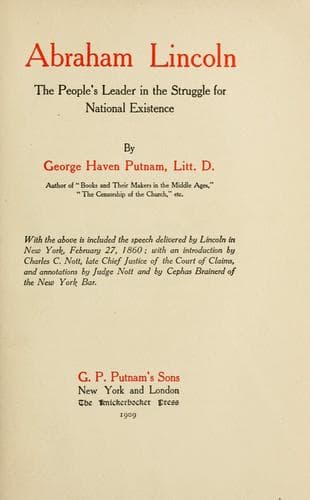
Abraham Lincoln: The People's Leader in the Struggle for National ExistencePutnam, George Haven
History
Abraham Lincoln: The People's Leader in the Struggle for National Existence
Putnam, George Haven
Lincoln, Abraham, 1809-1865; United States -- History -- Civil War, 1861-1865
[Footnote 5:--The Convention consisted of _sixty-five_ members. Of
these, _ten_ did not attend the Convention, and _sixteen_ did not sign
the Constitution. Of these sixteen, six refused to sign, and published
their reasons for so refusing, _viz._: Robert Yates and John Lansing, of
New-York; Edmund Randolph and George Mason, of Virginia; Luther Martin,
of Maryland, and Elbridge Gerry, of Mass. Alexander Hamilton alone
subscribed for New-York, and Rhode Island was not represented in the
Convention. The names of the "thirty-nine," and the States which they
represented are subsequently given.]
[Footnote 6:--The cession of Territory was authorized by New-York, Feb.
19, 1780; by Virginia, January 2, 1781, and again, (without certain
conditions at first imposed,) "at their sessions, begun on the 20th day
of October, 1783;" by Mass., Nov. 13, 1784; by Conn., May----, 1786; by
S. Carolina, March 8, 1787; by N. Carolina, Dec.----, 1789; and by
Georgia at some time prior to April, 1802.
The deeds of cession were executed by New-York, March 1, 1781; by
Virginia, March 1, 1784; by Mass., April 19, 1785; by Conn., Sept. 13,
1786; by S. Carolina, August 9, 1787; by N. Carolina, Feb. 25, 1790; and
by Georgia, April 24, 1802. Five of these grants were therefore made
before the adoption of the Constitution, and one afterward; while the
sixth (North Carolina) was authorized before, and consummated afterward.
The cession of this State contains the express proviso "that no
regulations made, or to be made by Congress, shall tend to emancipate
slaves." The cession of Georgia conveys the Territory subject to the
Ordinance of '87, except the provision prohibiting slavery.
These dates are also interesting in connection with the extraordinary
assertions of Chief Justice Taney, (19 How., page 434,) that "the
example of Virginia was soon afterwards followed by other States," and
that (p. 436) the power in the Constitution "to dispose of and make all
needful rules and regulations respecting the Territory or other property
belonging to the United States," was intended only "to transfer to the
new Government the property then held in common," "and has no reference
whatever to any Territory or other property which the new sovereignty
might afterwards itself acquire." On this subject, _vide Federalist_,
No. 43, sub. 4 and 5.]
[Footnote 7:--Sherman was from Connecticut; Mifflin from Penn.;
Williamson from North Carolina, and M'Henry from Maryland.]
[Footnote 8:--What Mr. M'Henry's views were, it seems impossible to
ascertain. When the Ordinance of '87 was passed he was sitting in the
Convention. He was afterwards appointed Secretary of War; yet no record
has thus far been discovered of his opinion. Mr. M'Henry also wrote a
biography of La Fayette, which, however, cannot be found in any of the
public libraries, among which may be mentioned the State Library at
Albany, and the Astor, Society, and Historical Society Libraries, at New
York.
Public-domain text, read in full here on John Shaqi.
Reviews
Reviews
No reviews yet
Be the first to share your thoughts on this work.
Elsewhere in the archive
Join the Discussion
Join the discussion
Sign in to leave a comment or review.
Sign InorCreate an account