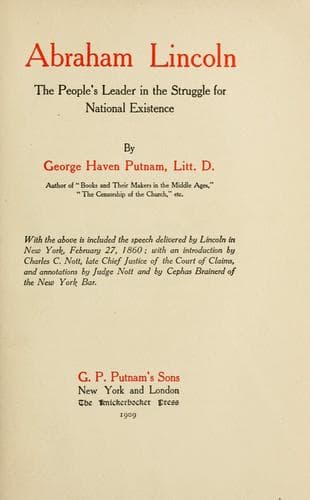
Abraham Lincoln: The People's Leader in the Struggle for National ExistencePutnam, George Haven
History
Abraham Lincoln: The People's Leader in the Struggle for National Existence
Putnam, George Haven
Lincoln, Abraham, 1809-1865; United States -- History -- Civil War, 1861-1865
Hamilton says of him, in a letter to Washington _(Works_, vol. vi., p.
65): "M'Henry you know. He would give no strength to the Administration,
but he would not disgrace the office; his views are good."]
[Footnote 9:--William Blount was from North Carolina, and William Few
from Georgia--the two States which afterward ceded their Territory to
the United States. In addition to these facts the following extract from
the speech of Rufus King in the Senate, on the Missouri Bill, shows the
entire unanimity with which the Southern States approved the
prohibition:
"The State of Virginia, which ceded to the United States her claims to
this Territory, consented, by her delegates in the Old Congress, to this
Ordinance. Not only Virginia, but North Carolina, South Carolina, and
Georgia, by the unanimous votes of their delegates in the Old Congress,
approved of the Ordinance of 1787, by which Slavery is forever abolished
in the Territory northwest of the river Ohio. Without the votes of these
States, the Ordinance could not have been passed; and there is no
recollection of an opposition from any of these States to the act of
confirmation passed under the actual Constitution."]
[Footnote 10:--"The famous Ordinance of Congress of the 13th July, 1787,
which has ever since constituted, in most respects, the model of all our
territorial governments, and is equally remarkable for the brevity and
exactness of its text, and for its masterly display of the fundamental
principles of civil and religious liberty."--_Justice Story, 1
Commentaries_: §1312.
"It is well known that the Ordinance of 1787 was drawn by the Hon.
Nathan Dane, of Massachusetts, and adopted with scarcely a verbal
alteration by Congress. It is a noble and imperishable monument to his
fame."--_Id._ note.
The ordinance was reported by a committee, of which Wm. S. Johnson and
Charles Pinckney were members. It recites that, "for extending the
fundamental principles of civil and religious liberty, which form the
basis whereon these republics, their laws and constitutions, are
erected; to fix and establish those principles as the basis of all laws,
constitutions, and governments which forever hereafter shall be formed
in the said Territory; to provide also for the establishment of States
and permanent government, and for their admission to a share in the
federal councils, on an equal footing with the original States, at as
early periods as may be consistent with the general interest--
"It is hereby ordained and declared, by the authority aforesaid, that
the following articles shall be considered as articles of compact
between the original States and the people and States in the said
Territory, and forever remain unalterable, unless by common consent, to
wit:"
Public-domain text, read in full here on John Shaqi.
Reviews
Reviews
No reviews yet
Be the first to share your thoughts on this work.
Elsewhere in the archive
Join the Discussion
Join the discussion
Sign in to leave a comment or review.
Sign InorCreate an account