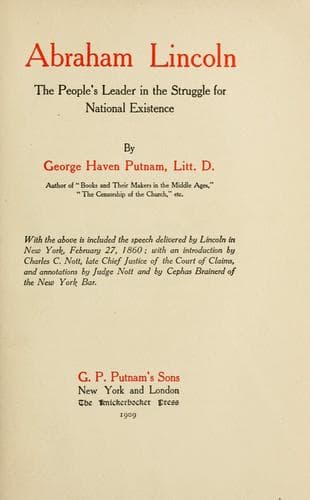
Abraham Lincoln: The People's Leader in the Struggle for National ExistencePutnam, George Haven
History
Abraham Lincoln: The People's Leader in the Struggle for National Existence
Putnam, George Haven
Lincoln, Abraham, 1809-1865; United States -- History -- Civil War, 1861-1865
[Footnote 20:--Although Mr. Pinckney opposed "slavery prohibition" in
1820, yet his views, with regard to the _powers_ of the general
government, may be better judged by his actions in the Convention:
FRIDAY, _June 8th,_ 1787.--"Mr. Pinckney moved 'that the National
Legislature shall have the power of negativing all laws to be passed by
the State Legislatures, which they may judge improper,' in the room of
the clause as it stood reported.
"He grounds his motion on the necessity of one supreme controlling
power, and he considers this as the _corner-stone_ of the present
system; and hence the necessity of retrenching the State authorities, in
order to preserve the good government of the national council."--T. 400,
_Elliott's Debates_.
And again, THURSDAY, _August 23d,_ 1787, Mr. Pinckney renewed the motion
with some modifications.--T. 1409. _Madison Papers_.
And although Mr. Pinckney, as correctly stated by Mr. Lincoln, "steadily
voted against slavery prohibition, and against all compromises," he
still regarded the passage of the Missouri Compromise as a great triumph
of the South, which is apparent from the following letter:
CONGRESS HALL, _March 2d_, 1820, 3 _o'clock at night_.
DEAR SIR:---I hasten to inform you, that this moment we have carried
the question to admit Missouri, and all Louisiana to the southward of
36° 30', free from the restriction of slavery, and give the South, in a
short time, an addition of six, perhaps eight, members to the Senate of
the United States. It is considered here by the slaveholding States as a
great triumph.
The votes were close--ninety to eighty-six--produced by the seceding and
absence of a few moderate men from the North. To the north of 36° 30,'
there is to be, by the present law, restriction; which you will see by
the votes, I voted against. But it is at present of no moment; it is a
vast tract, uninhabited, only by savages and wild beasts, in which not a
foot of the Indian claims to soil is extinguished, and in which,
according to the ideas prevalent, no land office will be opened for a
great length of time.
With respect, your obedient servant,
CHARLES PINCKNEY.
But conclusive evidence of Mr. Pinckney's views is furnished in the fact
that _he was himself a member of the Committee which reported the
Ordinance of_ '87, and that _on every occasion, when it was under the
consideration of Congress, he voted against all amendments_.--_Jour. Am.
Congress_, Sept. 29th, 1786. Oct. 4th. When the ordinance came up for
its final passage, Mr. Pinckney was sitting in the Convention, and did
not take any part in the proceedings of Congress.]
[Footnote 21:--By reference to notes 4, 6, 10, 13, 15, and 16 it will be
seen that, of the twenty-three who acted upon the question of
prohibition, twelve were from the present slaveholding States.]
[Footnote 22:--_Vide_ notes 5 and 17, _ante_.]
Public-domain text, read in full here on John Shaqi.
Reviews
Reviews
No reviews yet
Be the first to share your thoughts on this work.
Elsewhere in the archive
Join the Discussion
Join the discussion
Sign in to leave a comment or review.
Sign InorCreate an account