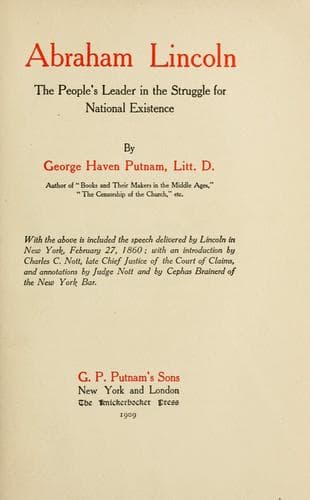
Abraham Lincoln: The People's Leader in the Struggle for National ExistencePutnam, George Haven
History
Abraham Lincoln: The People's Leader in the Struggle for National Existence
Putnam, George Haven
Lincoln, Abraham, 1809-1865; United States -- History -- Civil War, 1861-1865
Edmund Randolph, one of the framers of the Constitution, replied to Mr.
Henry, admitting the general force of the argument, but claiming that,
because of other provisions, it had no application to the _States_ where
slavery _then_ existed; thus conceding that power to exist in Congress
as to all territory belonging to the United States.
Dr. Ramsay, a member of the Convention of South Carolina, in his history
of the United States, vol. 3, pages 36, 37, says: "Under these liberal
principles, Congress, in organizing _colonies_, bound themselves to
impart to their inhabitants all the privileges of coequal States, as
soon as they were capable of enjoying them. In their infancy,
_government was administered for them_ without any expense. As soon as
they should have 60,000 inhabitants, they were authorized to call a
convention, and, by common consent, to form their own constitution. This
being done, they were entitled to representation in Congress, and every
right attached to the original States. These privileges are not confined
to any particular country or _complexion_. They are communicable to the
emancipated slave (for in the new State of Ohio, slavery is altogether
prohibited), to the copper-colored native, and all other human beings
who, after a competent residence and degree of civilization, are capable
of enjoying the blessings of regular government."]
[Footnote 12:--The Act of 1789, as reported by the Committee, was
received and read Thursday, July 16th. The second reading was on Friday,
the 17th, when it was committed to the Committee of the whole house, "on
Monday next." On Monday, July 20th, it was considered in Committee of
the whole, and ordered to a third reading on the following day; on the
21st, it passed the House, and was sent to the Senate. In the Senate it
had its first reading on the same day, and was ordered to a second
reading on the following day (July 22d), and on the 4th of August it
passed, and on the 7th was approved by the President.]
[Footnote 13:--The "sixteen" represented these States: Langdon and
Oilman, New Hampshire; Sherman and Johnson, Connecticut; Morris,
Fitzsimmons, and Clymer, Pennsylvania; King, Massachusetts; Paterson,
New Jersey; Few and Baldwin, Georgia; Bassett and Read, Delaware;
Butler, South Carolina; Carroll, Maryland; and Madison, Virginia]
[Footnote 14:--_Vide_ note 3, _ante_.]
[Footnote 15:--Chap. 28, § 7, U.S. Statutes, 5th Congress, 2d Session.]
[Footnote 16:--Langdon was from New Hampshire, Read from Delaware, and
Baldwin from Georgia.]
[Footnote 17:--Chap. 38, § 10, U.S. Statutes, 8th Congress, 1st
Session.]
[Footnote 18:--Baldwin was from Georgia, and Dayton from New Jersey.]
[Footnote 19:--Rufus King, who sat in the old Congress, and also in the
Convention, as the representative of Massachusetts, removed to New York
and was sent by that State to the U.S. Senate of the first Congress.
Charles Pinckney was hi the House, as a representative of South
Carolina.]
Public-domain text, read in full here on John Shaqi.
Reviews
Reviews
No reviews yet
Be the first to share your thoughts on this work.
Elsewhere in the archive
Join the Discussion
Join the discussion
Sign in to leave a comment or review.
Sign InorCreate an account