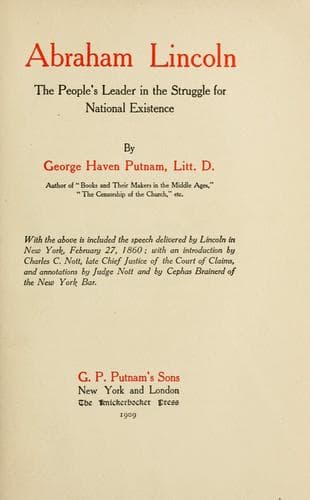
Abraham Lincoln: The People's Leader in the Struggle for National ExistencePutnam, George Haven
History
Abraham Lincoln: The People's Leader in the Struggle for National Existence
Putnam, George Haven
Lincoln, Abraham, 1809-1865; United States -- History -- Civil War, 1861-1865
[Footnote 27:--It is singular that while two of the "thirty-nine" were
in that Congress of 1819, there was but one (besides Mr. King) of the
"seventy-six." The one was William Smith, of South Carolina. He was then
a Senator, and, like Mr. Pinckney, occupied extreme Southern ground.]
[Footnote 28:--The following is an extract from the letter referred to:
"I agree with you cordially in your views in regard to negro slavery. I
have long considered it a most serious evil, both socially and
politically, and I should rejoice in any feasible scheme to rid our
States of such a burden. The Congress of 1787 adopted an ordinance which
prohibits the existence of involuntary servitude in our Northwestern
Territory forever. I consider it a wise measure. It meets with the
approval and assent of nearly every member from the States more
immediately interested in slave labor. The prevailing opinion in
Virginia is against the spread of slavery in our new Territories, and I
trust we shall have a confederation of free States."
The following extract from a letter of Washington to Robert Morris,
April, 12th, 1786, shows how strong were his views, and how clearly he
deemed emancipation a subject for legislative enactment: "I can only say
that there is no man living who wishes more sincerely than I do to see a
plan adopted for the abolition of it; but there is but one proper and
effective mode by which it can be accomplished, and that is, BY
LEGISLATIVE AUTHORITY, and that, as far as _my suffrage will go, shall
never be wanting_."]
[Footnote 29:--A Committee of five, consisting of Messrs. Mason, Davis,
and Fitch (Democrats), and Collamer and Doolittle (Republicans), was
appointed Dec. 14, 1859, by the U.S. Senate, to investigate the Harper's
Ferry affair. That Committee was directed, among other things, to
inquire: (1) "Whether such invasion and seizure was made under color of
any organization intended to subvert the government of any of the States
of the Union." (2) "What was the character and extent of such
organisation." (3) "And whether any citizens of the United States, not
present, were implicated therein, or accessory thereto, by contributions
of money, arms, munitions, or otherwise."
The majority of the Committee, Messrs. Mason, Davis, and Fitch, reply to
the inquiries as follows:
1. "There will be found in the Appendix a copy of the proceedings of a
Convention held at Chatham, Canada, of the Provisional Form of
Government there pretended to have been instituted, the object of which
clearly was to subvert the government of one or more States, and of
course, to that extent, the government of the United States." By
reference to the copy of Proceedings it appears that _nineteen_ persons
were present at that Convention, _eight_ of whom were either killed or
executed at Charlestown, and one examined before the Committee.
Public-domain text, read in full here on John Shaqi.
Reviews
Reviews
No reviews yet
Be the first to share your thoughts on this work.
Elsewhere in the archive
Join the Discussion
Join the discussion
Sign in to leave a comment or review.
Sign InorCreate an account