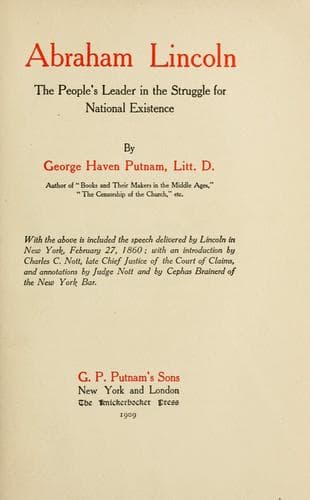
Abraham Lincoln: The People's Leader in the Struggle for National ExistencePutnam, George Haven
History
Abraham Lincoln: The People's Leader in the Struggle for National Existence
Putnam, George Haven
Lincoln, Abraham, 1809-1865; United States -- History -- Civil War, 1861-1865
2. "The character of the military organization appears, by the
commissions issued to certain of the armed party as captains,
lieutenants, etc., a specimen of which will be found in the Appendix."
(These Commissions are signed by John Brown as Commander-in-Chief, under
the Provisional Government, and by J.H. Kagi as Secretary.)
"It clearly appeared that the scheme of Brown was to take with him
comparatively but few men; but those had been carefully trained by
military instruction previously, and were to act as officers. For his
military force he relied, very clearly, on inciting insurrection amongst
the Slaves."
3. "It does not appear that the contributions were made with actual
knowledge of the use for which they were designed by Brown, although it
does appear that money was freely contributed by those styling
themselves the friends of this man Brown, and friends alike of what they
styled the cause of freedom (of which they claimed him to be an especial
apostle), without inquiring as to the way in which the money would be
used by him to advance such pretended cause."
In concluding the report the majority of the Committee thus characterize
the "invasion": "It was simply the act of lawless ruffians, under the
sanction of no public or political authority--distinguishable only from
ordinary felonies by the ulterior ends in contemplation by them," etc.]
[Footnote 30:--The Southampton insurrection, August, 1831, was induced
by the remarkable ability of a slave calling himself General Nat Turner.
He led his fellow bondsmen to believe that he was acting under the order
of Heaven. In proof of this he alleged that the singular appearance of
the sun at that time was a divine signal for the commencement of the
struggle which would result in the recovery of their freedom. This
insurrection resulted in the death of sixty-four white persons, and more
than one hundred slaves. The Southampton was the eleventh large
insurrection in the Southern States, besides numerous attempts and
revolts.]
Public-domain text, read in full here on John Shaqi.
Reviews
Reviews
No reviews yet
Be the first to share your thoughts on this work.
Elsewhere in the archive
Join the Discussion
Join the discussion
Sign in to leave a comment or review.
Sign InorCreate an account