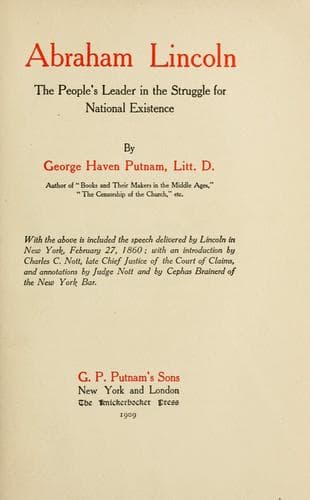
Abraham Lincoln: The People's Leader in the Struggle for National ExistencePutnam, George Haven
History
Abraham Lincoln: The People's Leader in the Struggle for National Existence
Putnam, George Haven
Lincoln, Abraham, 1809-1865; United States -- History -- Civil War, 1861-1865
"Lincoln and Hamlin, the Black Republican nominees, will be elected in
November next, and the South will then decide the great question whether
they will submit to the domination of Black Republican rule--the
fundamental principle of their organization being an open, undisguised,
and declared war upon our social institutions. I believe that the honor
and safety of the South, in that contingency, will require the prompt
secession of the slaveholding States from the Union; and failing then to
obtain from the free States additional and higher guaranties for the
protection of our rights and property, that the seceding States should
proceed to establish a new government. But while I think such would be
the imperative duty of the South, I should emphatically reprobate and
repudiate any scheme having for its object the separate secession of
South Carolina. If Georgia, Alabama, and Mississippi alone--giving us a
portion of the Atlantic and Gulf coasts--would unite with this State in
a common secession upon the election of a Black Republican, I would give
my consent to the policy."--_Letter of Hon. James L. Orr, of S.C., to
John Martin and others, July_ 23, 1860.]
[Footnote 34:--The Hon. John A. Andrew, of the Boston Bar, made the
following analysis of the Dred Scott case in the Massachusetts
Legislature. Hon. Caleb Cushing was then a member of that body, but did
not question its correctness.
"On the question of possibility of citizenship to one of the Dred Scott
color, extraction, and origin, three Justices, viz., Taney, Wayne, and
Daniels, held the negative. Nelson and Campbell passed over the plea by
which the question was raised. Grier agreed with Nelson. Catron said the
question was not open. McLean agreed with Catron, but thought the plea
bad. Curtis agreed that the question was open, but attacked the plea,
met its averments, and decided that a free-born colored person, native
to any State, is a citizen thereof by birth, and is therefore a citizen
of the Union, and entitled to sue in the Federal Courts.
"Had a majority of the court directly sustained the plea in abatement,
and denied the jurisdiction of the Circuit Court appealed from, then all
else they could have said and done would have been done and said in a
cause not theirs to try and not theirs to discuss. In the absence of
such a majority, one step more was to be taken. And the next step
reveals an agreement of six of the Justices, on a point decisive of the
cause, and putting an end to all the functions of the court.
Public-domain text, read in full here on John Shaqi.
Reviews
Reviews
No reviews yet
Be the first to share your thoughts on this work.
Elsewhere in the archive
Join the Discussion
Join the discussion
Sign in to leave a comment or review.
Sign InorCreate an account