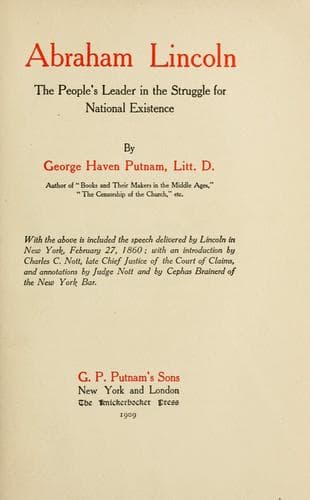
Abraham Lincoln: The People's Leader in the Struggle for National ExistencePutnam, George Haven
History
Abraham Lincoln: The People's Leader in the Struggle for National Existence
Putnam, George Haven
Lincoln, Abraham, 1809-1865; United States -- History -- Civil War, 1861-1865
"It is this. Scott was first carried to Rock Island, in the State of
Illinois, where he remained about two years, before going with his
master to Fort Snelling, in the Territory of Wisconsin. His claim to
freedom was rested on the alleged effect of his translation from a slave
State, and again into a free territory. If, by his removal to Illinois,
he became emancipated from his master, the subsequent continuance of his
pilgrimage into the Louisiana purchase could not add to his freedom, nor
alter the fact. If, by reason of any want or infirmity in the laws of
Illinois, or of conformity on his part to their behests, Dred Scott
remained a slave while he remained in that State, then--for the sake of
learning the effect on him of his territorial residence beyond the
Mississippi, and of his marriage and other proceedings there, and the
effect of the sojournment and marriage of Harriet, in the same
territory, upon herself and her children--it might become needful to
advance one other step into the investigation of the law; to inspect the
Missouri Compromise, banishing slavery to the south of the line of 36°
30' in the Louisiana purchase.
"But no exigency of the cause ever demanded or justified that advance;
for six of the Justices, including the Chief Justice himself, decided
that the _status_ of the plaintiff, as free or slave, was dependent, not
upon the laws of the State in which he had been, but of the State of
Missouri, in which he was at the commencement of the suit. The Chief
Justice asserted that 'it is now firmly settled by the decisions of the
highest court in the State, that Scott and his family, on their return
were not free, but were, by the laws of Missouri, the property of the
defendant.' This was the burden of the opinion of Nelson, who declares
'the question is one solely depending upon the law of Missouri, and that
the Federal Court, sitting in the State, and trying the case before us,
was bound to follow it.' It received the emphatic endorsement of Wayne,
whose general concurrence was with the Chief Justice. Grier concurred in
set terms with Nelson on all 'the questions discussed by him.' Campbell
says, 'The claim of the plaintiff to freedom depends upon the effect to
be given to his absence from Missouri, in company with his master in
Illinois and Minnesota, _and this effect is to be ascertained by
reference to the laws of Missouri_.' Five of the Justices, then (if no
more of them), regard the law of Missouri as decisive of the plaintiff's
rights."]
Public-domain text, read in full here on John Shaqi.
Reviews
Reviews
No reviews yet
Be the first to share your thoughts on this work.
Elsewhere in the archive
Join the Discussion
Join the discussion
Sign in to leave a comment or review.
Sign InorCreate an account