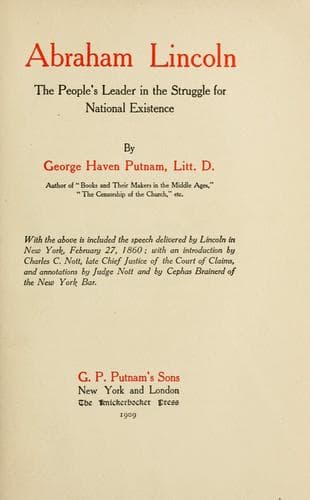
Abraham Lincoln: The People's Leader in the Struggle for National ExistencePutnam, George Haven
History
Abraham Lincoln: The People's Leader in the Struggle for National Existence
Putnam, George Haven
Lincoln, Abraham, 1809-1865; United States -- History -- Civil War, 1861-1865
[Footnote 35:--"Now, as we have already said in an earlier part of this
opinion upon a different point, the right of property in a slave is
distinctly and expressly affirmed in the Constitution. The right to
traffic in it, _like an ordinary article of merchandise and property_,
was guaranteed to the citizens of the United States in every State that
might desire it, for twenty years."--_Ch. J. Taney_, 19 _How. U.S.R_.,
p. 451. _Vide_ language of Mr. Madison, note 34, as to "_merchandise_."]
[Footnote 36:--Not only was the right of property _not_ intended to be
"distinctly and expressly affirmed in the Constitution"; but the
following extract from Mr. Madison demonstrates that the utmost care was
taken to avoid so doing:
"The clause as originally offered [respecting fugitive slaves] read, 'If
any person LEGALLY bound to service or labor in any of the United States
shall escape into another State," etc., etc. (Vol. 3, p. 1456.) In
regard to this, Mr. Madison says, "The term '_legally'_ was struck out,
and the words 'under the laws thereof,' inserted after the word State,
in compliance with the wish of some who thought the term 'legally'
equivocal and favoring the idea that slavery was legal in a moral point
of view."--_Ib_., p. 1589.]
[Footnote 37:--We subjoin a portion of the history alluded to by Mr.
Lincoln. The following extract relates to the provision of the
Constitution relative to the slave trade. (Article I, Sec. 9.)
_25th August_, 1787.--The report of the Committee of eleven being taken
up, Gen. [Charles Cotesworth] Pinckney moved to strike out the words
"the year 1800," and insert the words "the year 1808."
Mr. Gorham seconded the motion.
Mr. Madison--Twenty years will produce all the mischief that can be
apprehended from the liberty to import slaves. So long a term will be
more dishonorable to the American character than to say nothing about it
in the Constitution.
* * * * *
Mr. Gouverneur Morris was for making the clause read at once--
"The importation of slaves into North Carolina, South Carolina, and
Georgia, shall not be prohibited," etc. This, he said, would be most
fair, and would avoid _the _ ambiguity by which, under the power with
regard to naturalization, the liberty reserved to the States might be
defeated. He wished it to be known, also, that this part of the
Constitution was a compliance with those States. If the change of
language, however, should be objected to by the members from those
States, he should not urge it.
Col. Mason (of Virginia) was not against using the term "slaves," but
against naming North Carolina, South Carolina, and Georgia, lest it
should give offence to the people of those States.
Mr. Sherman liked a description better than the terms proposed, which
had been declined by the old Congress and were not pleasing to some
people.
Mr. Clymer concurred with Mr. Sherman.
Public-domain text, read in full here on John Shaqi.
Reviews
Reviews
No reviews yet
Be the first to share your thoughts on this work.
Elsewhere in the archive
Join the Discussion
Join the discussion
Sign in to leave a comment or review.
Sign InorCreate an account