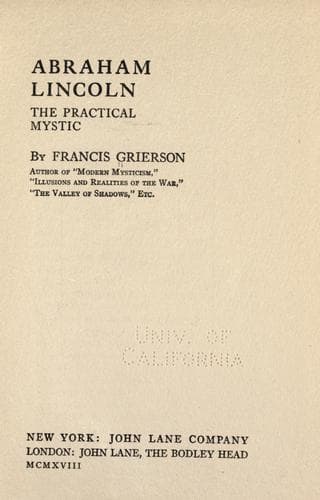
Abraham Lincoln: The Practical Mystic — John Shaqi
Abraham Lincoln: The Practical MysticGrierson, Francis
Religion
Abraham Lincoln: The Practical Mystic
Grierson, Francis
Lincoln, Abraham, 1809-1865 -- Psychology
"The existence of a great man," says Victor Cousin, the French
philosopher, "is not the creation of arbitrary choice; he is not a thing
that may, or may not, exist; he is not merely an individual; too much,
or too little, of individuality are equally destructive to the character
of a great man. On the one hand, individuality of itself is an element
of what is pitiful and little, because particularity, the contingent and
the finite, tends unceasingly to division, to dissolution, and to
nothingness. On the other hand, every general tends to absolute unity.
It possesses greatness but it is exposed to the risk of losing itself in
abstractions. The great man is the harmonious combination of what is
particular with what is general. This combination constitutes the
standard value of his greatness, and it involves a two-fold condition:
first, of representing the general spirit of his nation, because it is
in his relation to that general spirit that his greatness consists; and,
secondly, of representing the general spirit which confers upon his
greatness in his own person, in a real form, that is, in a finite,
positive, visible, and determinate form; so that what is general may not
suppress what is particular; and that which is particular may not
dissipate and dissolve what is general--that the infinite and the finite
may be blended together in that proportion which truly constitutes human
greatness."
All which applies to Lincoln.
"Conceive a great machine," wrote Guizot, the historian, "the design of
which is centred in a single mind, though its various parts are
entrusted to various workmen, separated from, and strangers to, each
other. No one of them understands the work as a whole, nor the general
result which he concerts in producing; but every one executes with
intelligence and freedom, by rational and voluntary acts, the particular
task assigned to him. It is thus that by the hand of man the designs of
Providence are wrought out in the government of the world. It is thus
that the two great facts, which are apparent in the history of
civilisation, come to co-exist. On the one hand, those portions of it
which may be considered as fated, or which happen without the control of
human knowledge or will; on the other hand, the part played in it by the
freedom and intelligence of man and what he contributes to it by means
of his own knowledge and will."
_His Miraculous Progress_
One of the most searching biographers of Lincoln maintains that between
the ages of fourteen and twenty-eight he displayed no sign of embryonic
or assured greatness.
Public-domain text, read in full here on John Shaqi.
Reviews
Reviews
No reviews yet
Be the first to share your thoughts on this work.
Join the Discussion
Join the discussion
Sign in to leave a comment or review.
Sign InorCreate an account