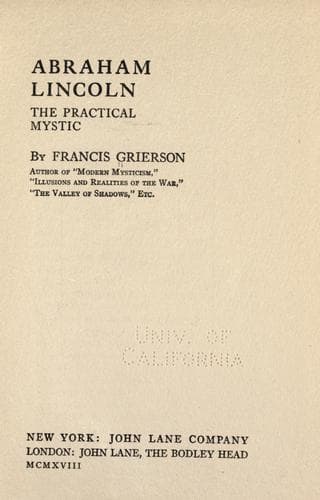
Abraham Lincoln: The Practical MysticGrierson, Francis
Religion
Abraham Lincoln: The Practical Mystic
Grierson, Francis
Lincoln, Abraham, 1809-1865 -- Psychology
Shakespeare makes of the gravedigger in _Hamlet_ a sort of clown with a
spade, and throughout all his dramas wit and humour, pathos and tragedy,
go hand in hand. Without his humour Shakespeare would have been little
more than an English Racine. With Lincoln, humour was made to serve a
high, psychic purpose. By its means he created a new atmosphere and new
conditions through which he could all the more freely work and act. He
brought humour into play for his own good as well as that of others. He
was not a theorist, or a dreamer of dreams; he was a practical mystic.
_A Prophecy Fulfilled_
In a letter written from Springfield, Illinois, August 15th, 1855, to
the Hon. George Robertson, of Lexington, Kentucky, Lincoln said:--
"The Autocrat of all the Russias will proclaim his subjects free sooner
than will our American Masters voluntarily give up their slaves."
On the day before Lincoln's first inauguration as President of the
United States the "Autocrat of all the Russias," Alexander the Second,
by Imperial decree emancipated his serfs, while six weeks after the
inauguration the "American Masters," headed by Jefferson Davis, began
the great war of secession to perpetuate and spread the institution of
slavery. This is only one of Lincoln's prophecies which proved true. In
stating them he did not pass into an abnormal state. He spoke as one
would speak of the coming weather. He did not consult the stars, nor any
person, before making a prophetic statement. Seeing clearly was as
natural to him as eating or sleeping. He was not a psychic machine,
uttering thoughts which seemed strange and enigmatical to himself,
because his intellectual and spiritual powers were part of himself.
Men of genius are not instruments in the vulgar meaning of the word.
They do not act in ignorance of what they are doing and saying. Lincoln,
more than any other, could give deliberate reasons for what he did and
said, and it is exceedingly difficult to name another in history who was
under such logical and commanding control of all the moral and
intellectual faculties. When he seemed to the superficial observer to be
dreaming, he was reasoning, calculating, comparing, analysing, weighing,
turning things upside down and inside out, until he satisfied the
dictates of his conscience and his sense of moral responsibility.
He placed no reliance on halfway measures and palliatives, no faith in
the workings of chance. He therefore was not, and could never have been,
a passive instrument in the hands of some unknown power. When it was
said of a certain musician that he composed his operas under the direct
influence of Mozart, the answer was: "Then who influenced Mozart?"
Great originality belongs to the mystical unity of the Supreme
Intelligence. Had Lincoln imitated Henry Clay, whom he so much admired
as a statesman and thinker, what would have become of Lincoln and the
country he governed?
Public-domain text, read in full here on John Shaqi.
Reviews
Reviews
No reviews yet
Be the first to share your thoughts on this work.
Join the Discussion
Join the discussion
Sign in to leave a comment or review.
Sign InorCreate an account